




Square or Rectangular Column Formwork
The execution of various types of foundations (raft, strip, and isolated), as well as concrete platforms, can be carried out efficiently and with ease by installing formwork panels, internal and external corner elements, and using connection components such as pins and wedges, clamps, and walers or braces (scaffolding pipes).
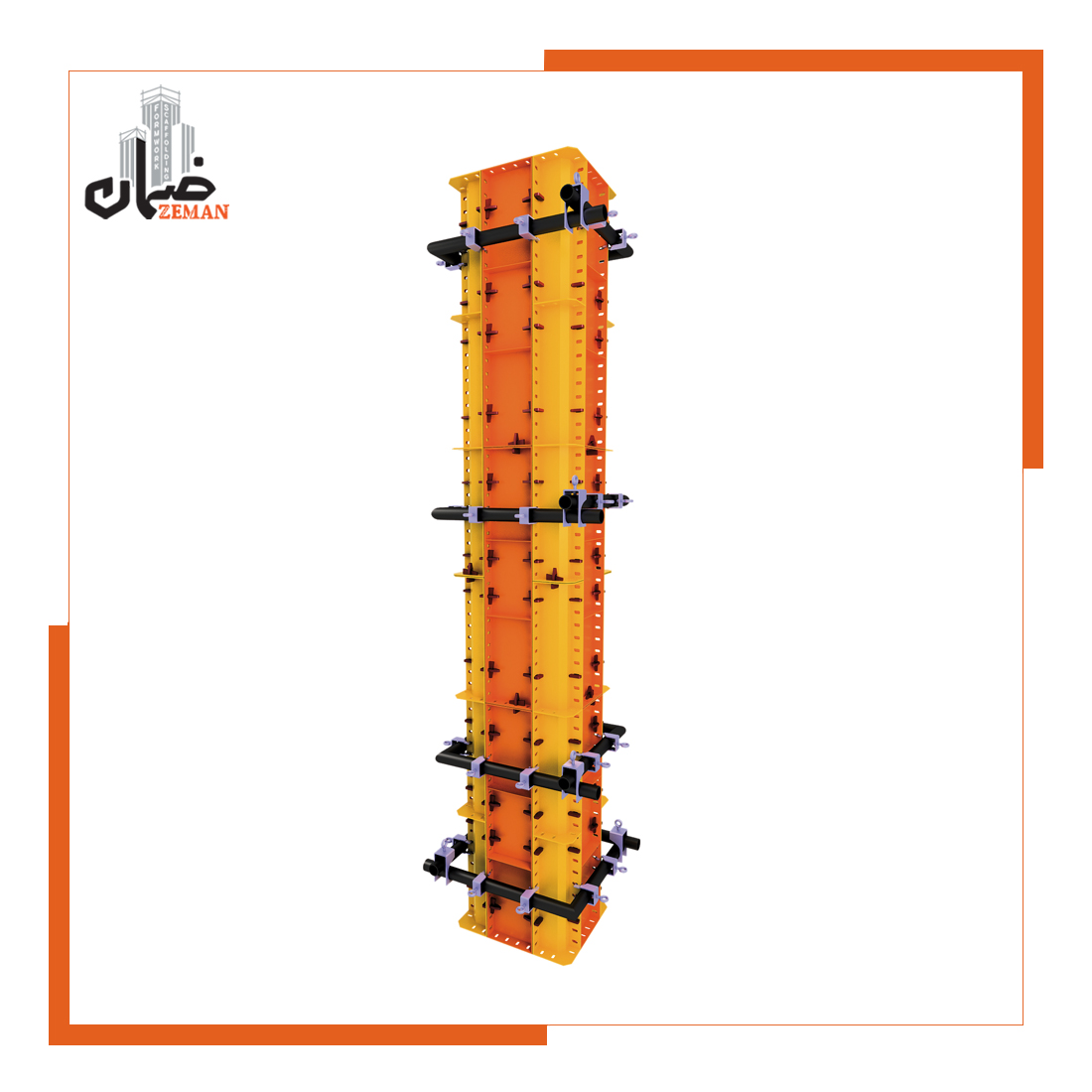
Each column formwork system consists of a set of components, including:
- Panels
- External corners
- Walings
- Connecting elements such as pins, wedges, and clamps
Panels are supplied in two types—bent and welded—depending on customer requirements. In both models, it is recommended to use stiffening measures to prevent deformation or twisting of the column formwork. It is also recommended that the height of external corner elements not be the same as that of the intermediate panels; accordingly, external corner heights of 150 cm and intermediate panel heights of 100 or 200 cm should be selected.
Square or Rectangular Column Formwork
Columns as Key Structural Elements and the Role of Square and Rectangular Formwork
Columns are among the most critical elements of reinforced concrete structures, as they transfer the loads imposed by the building to the foundation. For this reason, selecting the appropriate column type and accurately executing its formwork play a vital role in enhancing the strength and stability of the structure. Depending on structural and architectural requirements, columns are designed in various shapes, with square and rectangular sections being the most common.
One of the most important stages in the construction of concrete columns is formwork, which is responsible for shaping and supporting the concrete until it reaches its final strength. Square or rectangular column formwork is one of the most widely used methods in construction projects, and by observing proper technical principles, the quality and durability of columns can be effectively ensured. In this article, the principles and applications of square and rectangular column formwork are examined.
What Is Square or Rectangular Column Formwork?
Square or rectangular column formwork refers to selecting square or rectangular cross-sectional dimensions for columns and installing a temporary framework that maintains the shape and dimensions of the column during concreting. In square formwork, the column cross-section has equal dimensions, whereas in rectangular formwork, the column has two different width and depth dimensions. This type of formwork allows engineers to design and execute columns with greater precision based on structural and architectural requirements.
Formworks are typically made of timber, metal, or a combination of both, selected according to project type, environmental conditions, and budget. The use of appropriate formwork not only preserves the geometric shape of the column but also improves concrete quality and reduces material waste.
Advantages of Using Square and Rectangular Column Formwork
The use of square or rectangular column formwork offers numerous advantages. These formwork systems enable faster and more accurate concreting operations. In addition, due to their high strength and appropriate design, square and rectangular columns significantly enhance the durability of the structure. Therefore, selecting the correct formwork system has a substantial impact on the final quality of a construction project.
Simplicity in Design and Execution
One of the most important advantages of square and rectangular column formwork is the ease of design and construction. Due to their simple geometric shape, these columns can be easily used in various parts of a building, and the execution process becomes faster and more cost-effective for contractors.
Adequate Structural Strength
Square and rectangular columns generally possess high load-bearing capacity and are capable of supporting heavy building loads. Proper selection of column dimensions in each project ensures optimal performance and structural safety.
Flexibility in Application
Due to their simple and efficient structural configuration, these types of columns are widely used in various buildings, including multi-storey structures, warehouses, and commercial and residential complexes.
The Importance of Accurate Formwork in Square and Rectangular Columns
Column formwork is a critical stage in the construction of reinforced concrete structures, as it determines the final quality of columns and, consequently, the overall structural integrity of the building. Precise execution of formwork preserves the shape, dimensions, and integrity of the concrete during setting and prevents issues such as cracking, distortion, and concrete leakage. Therefore, close attention to formwork details and the use of standard formwork systems play a significant role in ensuring durability and structural safety. The most important reasons for the importance of accurate square and rectangular column formwork are discussed below:
Maintaining Column Dimensions and Geometry
Formworks play a fundamental role in accurately defining column dimensions and preventing any deviation or misalignment, which directly contributes to the final quality and strength of the structure.
Preventing Concrete Grout Leakage
Using suitable formworks prevents concrete grout from leaking outward, thereby avoiding material waste and the formation of surface voids in the column.
Improving Concrete Quality
A smooth and uniform formwork surface results in concrete columns free from cracks, voids, and visual defects, which enhances both aesthetic appearance and structural durability.
Ensuring Structural Safety
Proper formwork stabilizes columns during the early construction stages and prevents potential damage during concreting and subsequent construction processes.
Common Types of Formwork for Square or Rectangular Columns
- Timber Formwork: Made from wooden planks or plywood, this is one of the oldest and most common types of formwork. Its main advantages are affordability and easy availability; however, due to lower strength, it is less suitable for repeated use and large-scale projects.
- Metal Formwork: Metal formworks are manufactured from steel or aluminum sheets and offer high strength and durability. They can be reused multiple times and are therefore considered the best option for large, high-volume, and repetitive projects.
- Plastic Formwork: Plastic formworks are lightweight, easy to transport, and quick to assemble. They are mostly suitable for columns with smaller dimensions and help increase project execution speed.
Applications of Square and Rectangular Column Formwork
- Residential and Commercial Buildings: One of the most common applications of square and rectangular column formwork is in residential and commercial buildings. These columns are used in both interior spaces and building facades, playing a key role in enhancing structural strength and stability.
- Industrial Structures: In industrial projects such as warehouses and steel sheds, square and rectangular columns are considered an ideal option due to their high strength and cost-effective construction.
- Bridges and Railways: In large-scale projects such as bridge construction and railway infrastructure, square or rectangular column formwork is used for supporting columns and piers to ensure structural strength and long-term durability.
Selecting Appropriate Dimensions for Square or Rectangular Column Formwork
Selecting appropriate column dimensions depends on various factors, including applied structural loads, soil and environmental conditions, and the type of construction materials used. Accurate engineering design at this stage is critical to ensure that columns can effectively carry loads and guarantee structural stability.
Square Columns
Square columns are typically used when uniform load distribution in all directions is required. They are also a suitable option for limited spaces or areas with dimensional constraints.
Rectangular Columns
Rectangular columns are used when greater loads are applied in a specific direction. These columns are particularly effective in resisting lateral loads and concentrated forces in different parts of a structure.
Key Considerations in the Design of Square and Rectangular Columns
- Earthquake Resistance: In seismic regions, columns must be designed to effectively absorb and resist seismic forces and vibrations. The use of high-quality materials and proper structural design is essential to ensure reliable performance under critical conditions.
- Aesthetic Considerations: In addition to structural performance, column formwork design should also address aesthetic aspects. In modern architectural projects, the shape and appearance of columns play an important role in the final façade and visual appeal of the building.
Execution Stages of Square or Rectangular Column Formwork
Executing square and rectangular column formwork is one of the most important stages in the construction of concrete columns, directly affecting the final quality and durability of the structure. Precision at every stage of this process, from site preparation and formwork installation to concreting and stripping, is essential to prevent issues such as column misalignment, concrete leakage, and structural weakness. Therefore, adherence to technical principles and execution standards at each step ensures successful implementation and durable columns.
The main stages of executing square or rectangular column formwork are as follows:
1. Column Site Preparation
Initially, the ground surface must be fully leveled, smooth, and clean to allow accurate and high-quality formwork installation.
2. Formwork Installation
Formwork panels are carefully assembled and secured using bolts, clamps, or nails to ensure they remain completely stable under concrete pressure during pouring.
3. Formwork Bracing
Appropriate walers and bracing systems are installed to prevent formwork opening or deformation during concreting.
4. Alignment and Plumb Control
Using precise measuring tools, the levelness and verticality of the formwork are checked and adjusted as required.
5. Concrete Placement
Concrete is poured into the formwork and fully compacted using vibrators to minimize voids and achieve optimal concrete quality.
6. Formwork Removal
After the concrete has sufficiently set and reached the required strength, the formwork is removed to reveal the finished concrete column.
Conclusion
Square or rectangular column formwork, as a simple, economical, and efficient method, offers significant advantages in the design and construction of reinforced concrete structures. These types of columns are suitable options for various projects not only in terms of structural strength and performance but also from an architectural design perspective.
Careful consideration of technical details in selecting appropriate formwork, proper installation, and quality control during concreting plays a crucial role in enhancing the durability, quality, and appearance of columns. Furthermore, depending on project requirements and budget, timber, metal, or plastic formworks can be used, and proper standard execution ensures a long service life for the structure while reducing future maintenance and repair costs.
Get expert advice
Our sales experts at Zaman are ready to provide guidance and advice before your purchase.

Reviews
There are no reviews yet.