




Fully Threaded Tie Rod
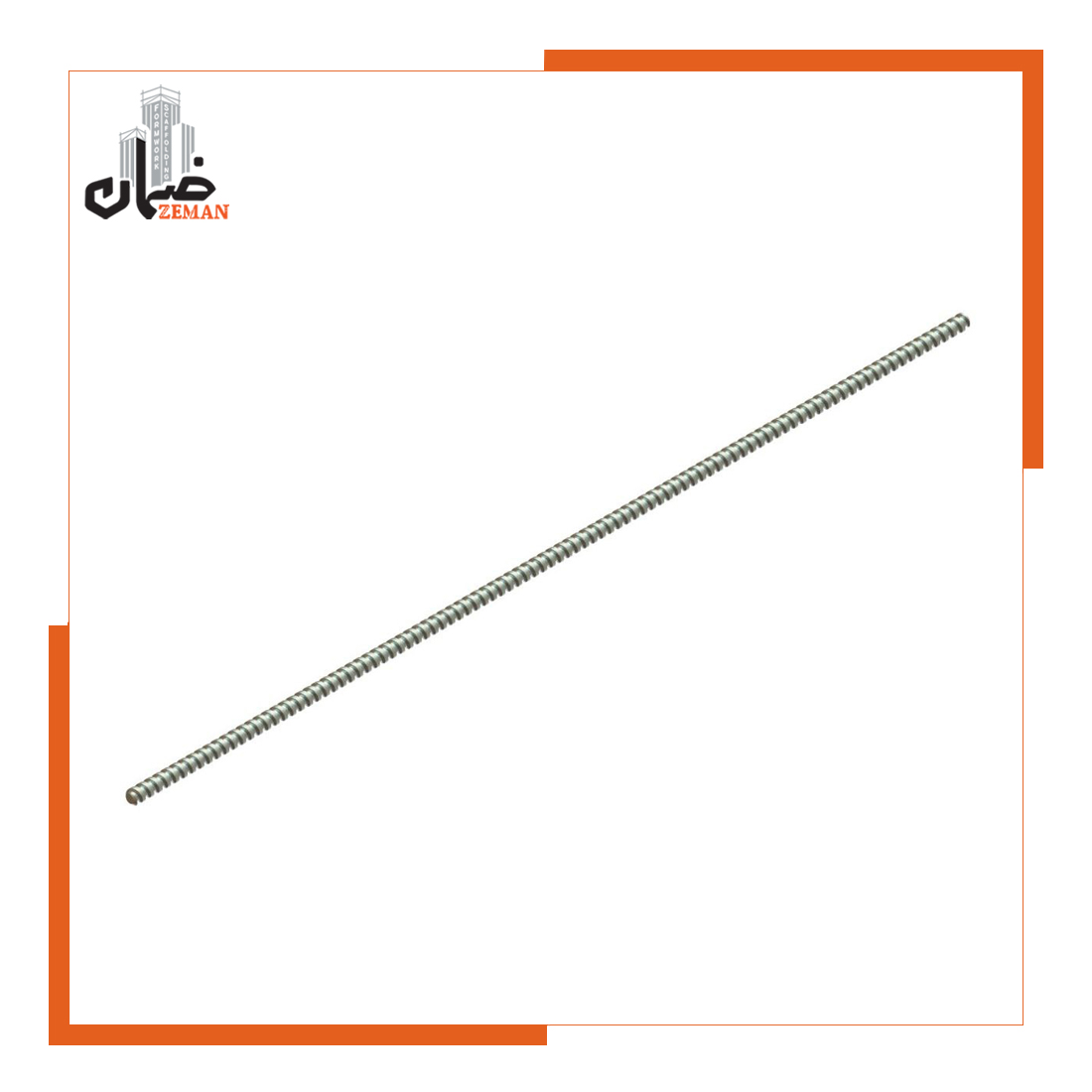
The Fully Threaded Bolt (also referred to as a Fully Threaded Tie Rod) is one of the essential components in concrete formwork equipment. Its primary function is to connect, stabilize, and secure concrete formwork panels against the pressure exerted by freshly poured concrete.
A fully threaded tie rod is a metal bar that is threaded along its entire length and is typically manufactured from high-strength ST37 carbon steel. These tie rods are installed between two formwork panels (for example, on opposite sides of a concrete wall) and are tightened securely using wing nuts and bearing washers on both ends.
Main applications:
- Used in concrete wall formwork to prevent panel separation caused by hydrostatic pressure of fresh concrete.
- Fixing and securing soldiers or walers to the formwork system.
- Providing precise adjustment of the distance between formwork panels by means of threaded nuts.
The fully threaded tie rod is typically used together with the following components:
- Washered Wing Nut: Used to firmly tighten the tie rod from the outside of the formwork.
- Water Stop Tie Rod: Used to prevent water leakage through tie rod holes in structures such as tanks and swimming pools.
- Steel Formwork Panels: The primary elements that receive and resist the pressure of fresh concrete.
Fully Threaded Tie Rod
Introduction: The Fully Threaded Tie Rod, the Hidden Champion of Robust Concrete Structures
When observing a massive concrete structure such as a high-rise tower, a retaining wall, or a bridge pier, one naturally admires its strength and geometric precision. This stability is the result of the coordinated performance of countless components, many of which remain hidden from view after project completion. The fully threaded tie rod is one of these vital hidden champions. Positioned at the core of concrete formwork systems, it plays a fundamental role in ensuring structural safety and integrity.
A fully threaded tie rod is a high-tensile steel bar threaded along its entire length, functioning as the primary tensile element in formwork systems. Its critical responsibility is to connect formwork panels on opposite sides of a wall and to resist the extremely high hydrostatic pressure exerted by fresh concrete. This pressure can easily force the formwork apart, leading to system failure (bulging) or collapse. By restraining these forces, the tie rod prevents such catastrophic outcomes.
Although the concept of a simple threaded bar may appear straightforward, the engineering, materials science, and quality control required to manufacture a reliable tie rod for concrete formwork are highly complex and precise. ZEMANCO, as a leading manufacturer of formwork equipment, considers itself not merely a supplier but an engineering partner committed to delivering components that ensure the highest levels of structural integrity and job-site safety.
The distinction between an engineered “tie rod” designed to withstand heavy loads and a generic “threaded rod” intended for light-duty applications such as suspending mechanical ducts lies precisely here. Choosing correctly between the two can mean the difference between a successful project and a costly, hazardous failure.
The Critical Role of Tie Rods in Formwork Engineering: Resisting Hydrostatic Concrete Pressure
Before initial setting, fresh concrete behaves much like a dense fluid and exerts significant hydrostatic pressure on formwork walls. This pressure increases exponentially with the height of the concrete pour and the rate of placement. In projects such as high-rise buildings, towers, or long, continuous walls, the pressure can reach several tons per square meter. Restraining this immense force is the primary challenge in formwork system design.
This is where the tie rod, together with its accessories, forms a complete tension-resisting system. The system consists of the tie rod, wing nuts and bearing washers, and soldiers (walers). The tie rod passes through pre-formed holes in the formwork panels, and the nuts are tightened on both sides behind the soldiers. In this way, the entire lateral pressure of the concrete is transferred into tensile stress along the steel tie rod. Consequently, selecting the diameter, grade, and spacing of tie rods is not a simple procurement decision but a precise engineering calculation based on wall height, pouring rate, and concrete properties.
Using non-standard or low-quality tie rods can lead to disastrous consequences. Failure of a tie rod under load results in a phenomenon known as formwork blowout. This event poses severe safety hazards due to the projection of formwork elements and the sudden release of concrete, while also imposing substantial direct costs, including wasted concrete, labor for cleanup and repair, and project schedule delays. Furthermore, deformation of formwork panels can cause dimensional inaccuracies in the final structure and result in honeycombing, compromising overall structural integrity.
Technical Breakdown of the ZEMANCO Fully Threaded Tie Rod
To fully appreciate the importance of this component, its technical specifications must be examined in detail. This section provides an in-depth analysis of the standards, raw materials, dimensions, and protective coatings that distinguish a high-quality tie rod from similar products.
Precise Terminology: Threaded Rod, Tie Rod, and Stud Bolt
In the industrial fastener market, various terms are often used interchangeably, which can lead to confusion. Understanding their differences is essential for making a correct engineering decision:
- Threaded Rod: A general term for any fully threaded bar. These products are typically manufactured in lower grades (such as 4.8 or 5.6) and are used in low-stress applications, including building services, duct suspension, or light steel structures.
- Tie Rod: This term describes the specialized application of an engineered threaded rod. Tie rods are specifically designed and manufactured to withstand high tensile loads in concrete formwork. Strict quality control, the use of higher steel grades (such as 8.8), and sometimes special thread profiles are their defining characteristics. This product category represents ZEMANCO’s core expertise.
- Stud Bolt: Although also a threaded bar, stud bolts are generally made from high-alloy steels under stringent standards such as ASTM A193. Their primary application is in high-pressure pipeline flange connections within the oil, gas, and petrochemical industries and should not be confused with formwork tie rods.
Manufacturing Standards: Ensuring Quality and Safety
Producing industrial components in accordance with recognized international standards guarantees quality, safety, and reliability. For tie rod manufacturing, two standards issued by the German Institute for Standardization (DIN) are most commonly referenced:
- DIN 975: The classic standard for fully threaded rods, defining dimensional characteristics, thread pitch, and tolerances. Although officially replaced by newer standards, it is still widely referenced in the industry.
- DIN 976: A more modern replacement for DIN 975, covering both fully threaded rods and stud bolts with defined lengths. Familiarity with these standards and their differences reflects an up-to-date level of technical expertise.
Adherence to these standards ensures full compatibility between tie rods and standard accessories such as nuts and washers, resulting in predictable and reliable performance.
Raw Materials and Grades: The Core of Tensile Strength
The strength of a tie rod directly depends on the steel material and grade used in its manufacture. Selecting the appropriate raw material is based on load requirements and environmental conditions.
- Low-Carbon Steel: Includes grades 4.8 and 5.6, offering economical pricing but lower tensile strength (for example, Grade 5.6 has a minimum tensile strength of 500 MPa). Suitable for light foundation formwork and short walls.
- Medium-Carbon Steel: Grades such as 8.8 and 10.9 fall into this category. After production, these steels undergo quenching and tempering, significantly increasing tensile strength. Grade 8.8 is the industry standard for heavy-duty formwork, tall walls, and reusable modular formwork systems.
- Stainless Steel: Grades A2 (equivalent to 304) and A4 (equivalent to 316) are selected for their exceptional corrosion resistance. A2 is suitable for general humid environments, while A4, containing molybdenum, offers excellent performance in highly corrosive conditions such as marine environments and chlorine-exposed structures (e.g., treatment plants).
Get expert advice
Our sales experts at Zaman are ready to provide guidance and advice before your purchase.

Reviews
There are no reviews yet.