




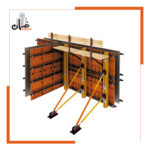
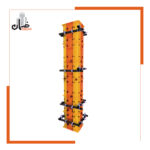
Foundation Formwork
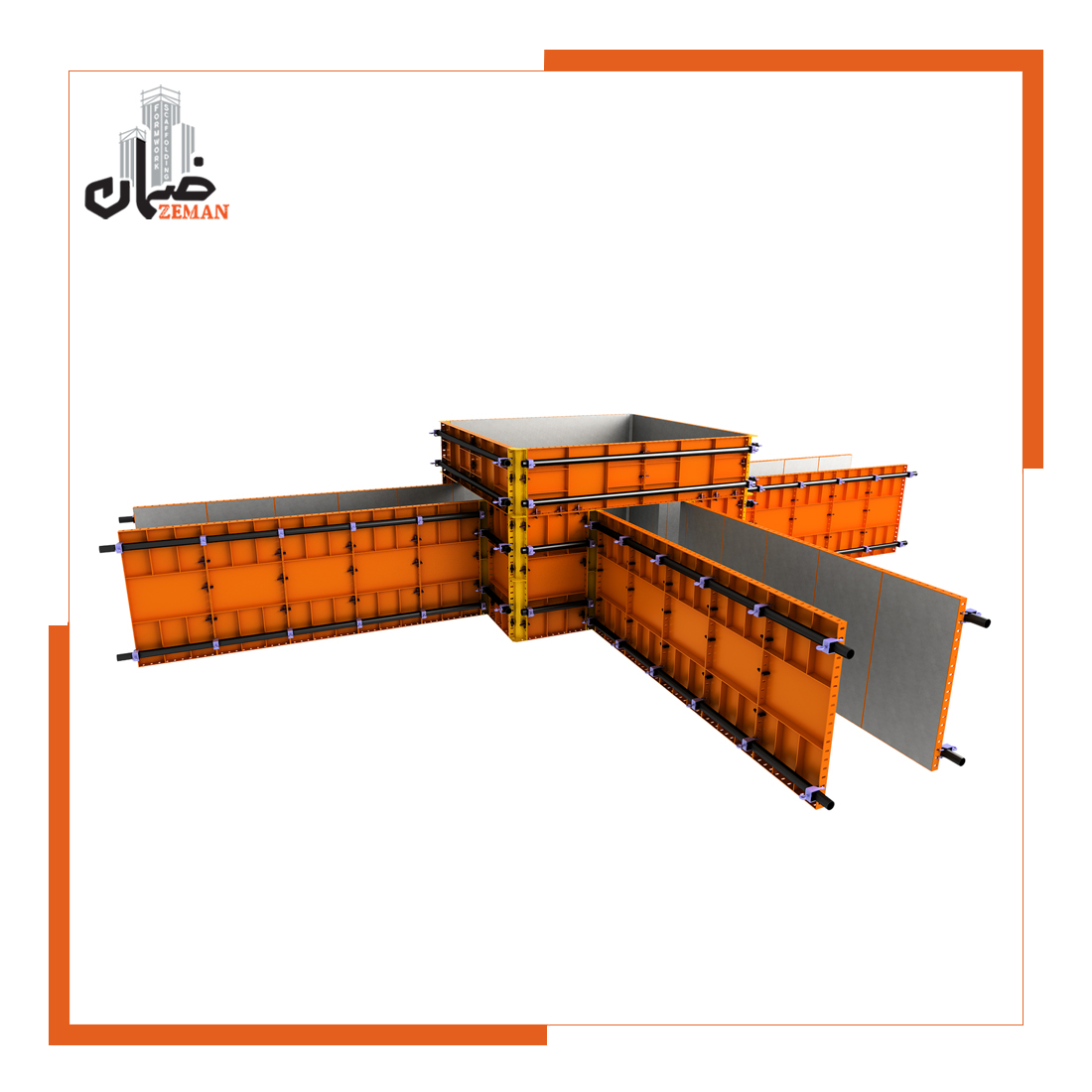
Foundation formwork is a process in which various types of formwork systems are used to shape the fresh concrete of a building’s foundation. These formworks help maintain precise dimensions, proper leveling, and the structural integrity of the foundation. The use of strong and high‑quality formwork systems increases the overall durability of the structure, prevents potential structural defects, and reduces future maintenance and repair costs. Foundation formwork is applicable to projects of all scales, from small to large developments, and depending on project requirements, timber formwork, metal foundation formwork, or steel formwork can be utilized.
The execution of different types of foundations, including raft (mat), strip, and isolated footings, as well as concrete pedestals and platforms, can be carried out efficiently by installing formwork panels, internal and external corner elements, and utilizing connection and fastening components such as pins and wedges, clamps, and walers or braces (scaffolding pipes).
Foundation Formwork
Foundation formwork, as one of the key stages in construction projects, plays a vital role in ensuring the strength and durability of a structure. The foundation, which serves as the base and backbone of any building, must be executed with precision and in accordance with engineering principles to guarantee structural safety and long-term performance. In this process, foundation formwork is responsible for shaping fresh concrete and maintaining the exact dimensions and proper leveling of the foundation. Selecting the appropriate type of formwork, applying correct installation methods, and executing foundation formwork in compliance with standards not only prevents material waste but also improves concrete quality and reduces future maintenance and repair costs.
What Is a Foundation?
A foundation, also referred to as a footing, is the substructure element that transfers the loads imposed by the building to the ground. The strength and durability of any structure depend directly on the quality of design and execution of this component. During construction, foundation formwork plays a critical role in shaping the concrete accurately and achieving precise dimensions and alignment. Proper foundation design must ensure uniform load distribution to the soil and prevent differential settlement.
Types of Foundation Formwork
Foundation formwork is a process in which fresh concrete is shaped using a temporary framework to maintain the exact dimensions and level of the foundation. The choice of formwork type depends on factors such as project type, formwork material, budget, and environmental conditions. The main types of foundation formwork include the following:
Timber Foundation Formwork
These formworks are made of timber boards or plywood and are characterized by easy installation and low initial cost. However, their resistance to moisture and concrete pressure is limited, and they are generally used in small-scale or temporary projects.
Metal Foundation Formwork
Manufactured from steel or aluminum sheets, these formworks offer high strength and load-bearing capacity. Although their initial cost is higher than that of timber formworks, their durability and higher dimensional accuracy effectively offset the additional expense.
Metal Foundation Formwork Consists of the Following Components:
Panel
The panel consists of a steel facing sheet with a thickness of 2 to 4 mm (based on structural calculations), along with stiffeners. The steel sheet is the primary component of the panel; therefore, higher steel quality directly results in improved formwork performance and durability.
Horizontal Walers (Soldiers)
These components are made of steel pipes or box sections and are connected to the panels using appropriate clamps. They play a crucial role in maintaining the stability and integrity of the formwork system.
Braces and Strongbacks
These elements are fabricated from lightweight box profiles or cold-formed sections. Their function is to enhance lateral strength and securely fix the panels in place.
Key Characteristics of Standard Metal Formworks Include:
- Standard metal formworks are those whose dimensions are multiples of 5 cm (the basic modular unit of formwork systems in Iran is 5 and 10 cm).
- The facing surface is made of 3 mm thick black steel sheet and, depending on applied loads, is reinforced with steel ribs or flat bars of 3 or 4 mm thickness.
- The perimeter flat bars are perforated with holes at exactly 5 cm center-to-center spacing, allowing clamps to be installed at any required position.
- Metal formworks are typically manufactured from St37 steel sheets. As the steel facing is the main component of the panel, higher-quality sheets result in superior formwork performance. Mobarakeh Steel sheets are flat, uniform in thickness, and offer better overall quality.
- Using low-quality formworks leads to uneven concrete surfaces and improper vertical alignment. The use of aluminum in surfaces that come into direct contact with concrete—especially facing sheets—is prohibited due to its negative impact on concrete quality.
- Due to the chemical reaction between cement and the internal surface of aluminum pipes, hydrogen gas is generated, which can reduce concrete strength by up to 50%.
- Traditionally, metal formworks were produced in two types: bent-edge and strip or welded systems. Today, modern systems such as large panels, tunnel formwork, and other specialized formwork solutions are widely used.
- In strip-type formworks, the facing sheet is typically 3 mm thick, while the reinforcing strips are made of 5 mm thick steel.
- Bent-edge formworks are manufactured as single-piece units from 3 mm steel sheets, with edges bent using specialized machinery.
- It is mandatory to apply form oil to panel surfaces prior to concreting to prevent concrete adhesion and facilitate easy form removal.
Advantages of Metal Formwork
- Long service life
- High speed of assembly and form removal
- Creation of smooth and uniform concrete surfaces
- Adequate fire resistance
- High resistance to applied loads
- Reduced on-site work due to prefabricated components
- Ability to quickly adjust load-bearing capacity
- Cleaner working environment compared to other formwork types
- Cost advantages due to reduced dependency on imports
Brick Foundation Formwork
In traditional or low-budget projects, bricks are sometimes used for foundation formwork. This method is non-permanent and is mainly applied to small or temporary foundations.
Steel Foundation Formwork
These formworks are made of high-strength steel and offer an exceptionally long service life. They are suitable for large-scale, industrial, and repetitive projects and provide excellent resistance to pressure and impact.
Foundation Formwork Execution Method
Proper execution of foundation formwork requires adherence to defined stages and technical principles to ensure high-quality concreting and a durable foundation. The main stages include:
Ground Preparation and Excavation
Initially, the project location is set out according to execution drawings, and excavation works are carried out with precision.
Leveling the Foundation Base
The foundation base must be completely level and smooth to ensure correct formwork installation and prevent differential settlement.
Installing the Formworks in the Designated Position
Formworks are positioned according to foundation dimensions and layout, and their placement is verified using construction drawings.
Bracing the Formworks to Prevent Deformation
Proper bracing and robust accessories are used to maintain formwork shape and stability against concrete pressure.
Concrete Placement Inside the Formworks
After confirming correct installation and bracing, concrete placement is carried out, ensuring uniform distribution within the formworks.
Foundation Form Removal
After the initial setting of concrete—typically between 24 and 48 hours—the foundation formwork is removed. The exact timing depends on factors such as concrete type, weather conditions, and applied loads. Timely and proper form removal prevents damage to fresh concrete and ensures the final quality of the foundation.
Important Considerations in Foundation Formwork
To achieve successful foundation formwork execution, the following points should be observed:
- Use of strong, fully leveled formworks to maintain accurate foundation dimensions
- Prevention of grout leakage through proper joint sealing
- Adequate bracing to prevent displacement or deformation during concreting
- Lubrication of inner form surfaces to facilitate stripping and extend formwork lifespan
Characteristics of a Good Foundation Formwork
An appropriate foundation formwork should possess the following characteristics:
- High resistance to fresh concrete pressure and weight
- Reusability and long service life to reduce costs
- Smooth and uniform surface for defect-free concrete finish
- Easy installation and dismantling to accelerate project execution
Strip Foundation Formwork
In strip foundation formwork, formworks are installed continuously along the foundation path. This method is commonly used for buildings with load-bearing walls or lightweight structures and contributes to creating a strong and uniform foundation. In addition to fast execution, strip foundation formwork provides high accuracy in maintaining alignment and dimensions.
Raft (Mat) Foundation Formwork
A raft or mat foundation is a type of shallow foundation constructed beneath the entire structure or a major portion of it to distribute building loads uniformly to the ground. This foundation type is typically used when loads are heavy or soil bearing capacity is low.
Due to large surface area and integrated geometry, raft foundation formwork usually involves a combination of timber or metal formworks along with robust bracing systems. The execution stages include:
- Leveling and preparing the foundation base
- Installing perimeter formworks around the foundation area
- Using walers and braces to prevent formwork opening under concrete pressure
- Concrete placement and surface finishing
This method requires high precision, as even minor errors in leveling or vertical alignment can lead to structural problems.
Isolated Foundation Formwork
Isolated foundation formwork refers to the process of forming individual footings, typically used for small buildings or when loads are concentrated at specific points. This type of foundation is suitable for structures with lower load demands or sites with favorable soil conditions.
In isolated foundation formwork, formworks are installed separately for each footing location. This method is generally simpler and more cost-effective than other foundation types. Formworks can be made from timber, metal, or steel and must be accurately leveled to ensure proper foundation geometry.
This foundation type is commonly used for column footings or concentrated loads, such as low-rise buildings, villas, or light industrial structures.
Advantages of Raft Foundation Formwork
- High strength and stability under heavy loads
- Uniform distribution of structural loads
- Suitable for large-scale and industrial structures
In large projects, modular metal formworks are commonly used instead of full timber systems to increase speed and maintain dimensional accuracy.
Foundation Formwork Cost
The cost of foundation formwork depends on several factors that can cause significant variations in overall project expenses. Key influencing factors include:
1. Type of Formwork
- Timber Formwork: Generally lower in cost and suitable for small or short-term projects. Pricing depends on wood type, board thickness, and material quality.
- Metal Formwork: Offers higher durability and precision, resulting in higher costs. It is more economical for large or long-term projects.
- Steel Formwork: Ideal for major industrial projects, with higher costs due to superior strength and long service life.
- Modular Formwork: For large commercial projects requiring speed and dimensional accuracy, steel modular formwork systems or modular metal formwork are the most suitable options.
2. Project Size and Dimensions
Larger foundation areas require more formworks, increasing overall costs. Projects with extensive or deep foundations typically have higher expenses.
Design complexity: Projects requiring special or complex formworks increase overall cost.
3. Concrete Type and Environmental Conditions
- Concrete type: Using special concretes such as waterproof or high-strength concrete can affect formwork costs.
- Environmental conditions: Projects in harsh climates (high humidity or temperature extremes) may require special materials or reinforced formworks, increasing costs.
4. Labor Costs
Labor costs significantly influence foundation formwork pricing. Large or complex projects require more workers and longer execution time. Contractor fees may also vary depending on installation complexity.
5. Geographical Location
Project costs vary by location. Urban areas or regions with limited access to materials and equipment usually incur higher costs.
Transportation costs: Delivering formworks and materials to the site also adds to expenses.
Cost of Timber Foundation Formwork
The cost of timber foundation formwork depends on factors such as wood type, board thickness, project size and volume, labor costs, and project location. Although timber formwork is generally cheaper than metal formwork, its high wear rate and frequent replacement make it less suitable for long-term projects.
Conclusion
Foundation formwork is a critical and indispensable stage in any construction project, from small buildings to large industrial developments. Using strong, level, and high-quality formworks ensures accurate foundation dimensions, enhances structural durability, and reduces future maintenance costs. Proper formwork selection and standard execution represent a sound investment that prevents structural issues and financial losses in the future.
Foundation Formwork FAQs
What Is Foundation Formwork?
Foundation formwork refers to the process of installing temporary frameworks used to shape fresh concrete for building foundations while maintaining proper dimensions, alignment, and strength.
What Is the Best Type of Foundation Formwork?
The best type of foundation formwork depends on project size, budget, and environmental conditions. Metal and steel formworks offer higher durability and strength, while timber formwork is more economical for small and short-term projects.
How Long Does It Take to Remove Foundation Formwork?
Formworks are typically removed 24 to 48 hours after concrete placement, depending on ambient temperature, concrete type, and site conditions.
What Are the Key Considerations in Foundation Formwork?
Key considerations include proper leveling, adequate bracing, prevention of concrete grout leakage, and the use of durable formwork systems.
How Is Foundation Formwork Cost Calculated?
Foundation formwork cost depends on the type of formwork (timber, metal, or steel), project area, material quality, and labor costs.
Get expert advice
Our sales experts at Zaman are ready to provide guidance and advice before your purchase.

Reviews
There are no reviews yet.