




Formwork at Height
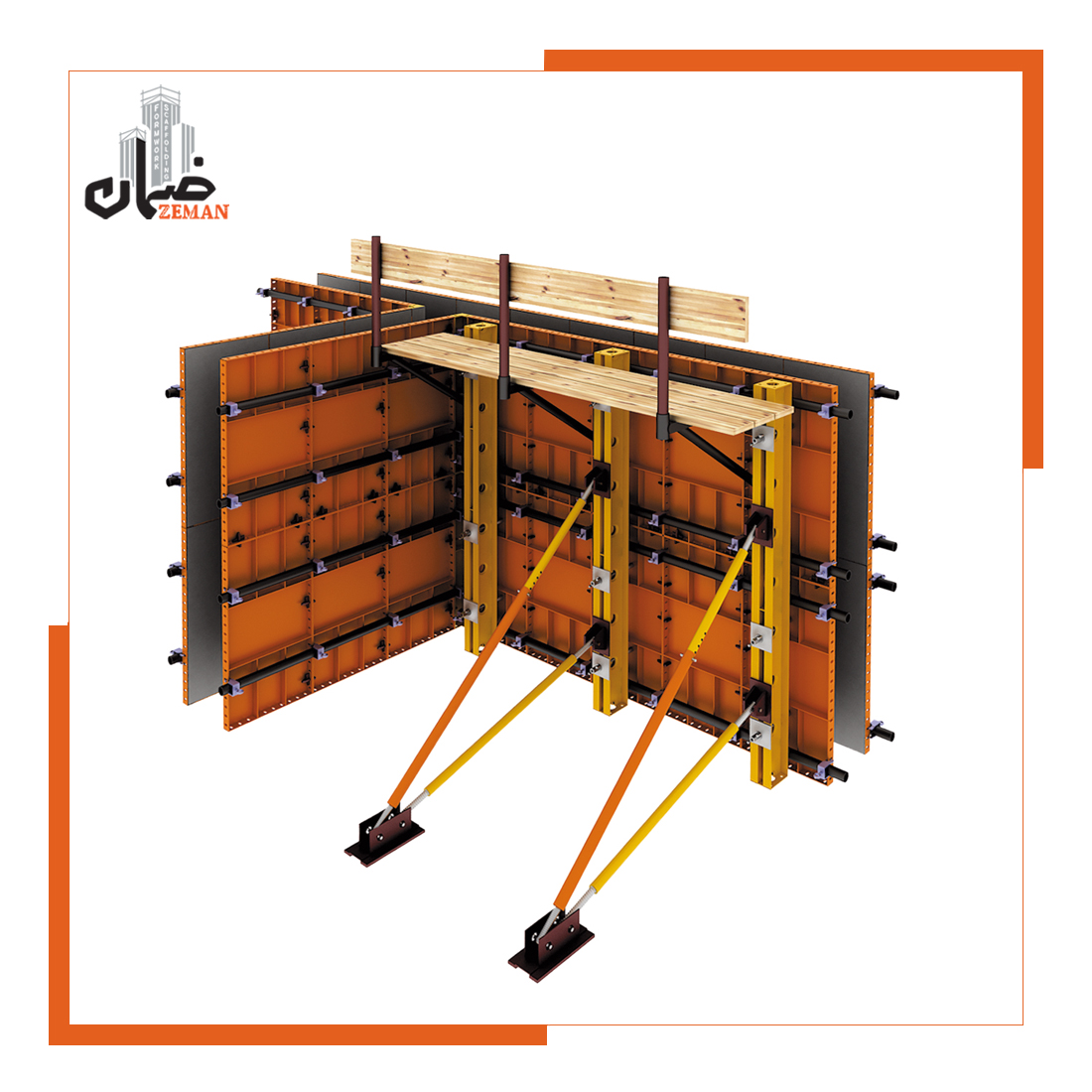
In the execution of tall concrete structures such as walls, tanks, and dams—where climbing formwork systems are employed—brackets are used as the primary structural component of the system. In one-sided climbing formwork applications, the bracket withstands all forces resulting from the self-weight of the formwork, concrete pressure, and imposed worker loads, and based on its truss-type structural behavior, transfers these vertical loads horizontally to the anchor bolts embedded in the concrete wall of the previous construction stage.
Brackets can be utilized at any elevation, eliminating the need for scaffolding to transfer gravitational loads to the ground. Due to this advantage, bracket systems provide significant economic and operational superiority in the formwork of high-rise structures compared to conventional methods. The bracket creates a temporary yet stable working platform that serves as a reliable support for formwork installation, while also providing the necessary space for formwork operations and precise vertical (plumb) alignment. The bracket is connected to the concrete structure by means of bolts or anchor bolts, and after each concreting stage, it is relocated—either together with the formwork or independently—by crane to the next higher level.
Formwork at Height
What Is Formwork at Height?
Formwork at height refers to a set of methods and techniques used for the construction of tall and structurally safe buildings in construction and civil engineering projects. This process involves the use of tools, equipment, and specialized systems that enable the construction of walls, columns, slabs, and other structural elements at elevated levels.
Formwork at height is particularly important in the construction of towers, high-rise buildings, bridges, communication towers, and other large-scale structures with significant elevation. These formwork systems are typically manufactured from strong yet lightweight materials to withstand various loads and concrete pressures while allowing for easy installation, dismantling, and transportation.
This process may include the following:
- Use of Scaffolding: To provide access to different elevations and to facilitate formwork installation.
- Temporary and Permanent Formwork: Used for placing concrete in reinforced concrete structures.
- Automated Formwork Systems: Such as slipform and mechanized systems that increase construction speed and execution accuracy.
- Enhanced Safety Measures: In high-level formwork, worker safety is ensured through proper guardrails, safety helmets, harnesses, and other protective equipment.
In general, formwork at height, as one of the key components in the construction of tall structures, requires precise planning, appropriate equipment, and special attention to safety considerations.
In the modern construction industry, the use of advanced concrete formwork systems has led to a significant improvement in construction speed, quality, and execution accuracy. In projects involving considerable height, selecting an appropriate formwork system is critically important, as it not only ensures high-quality concrete placement but also guarantees workforce safety and reduced construction time.
Types of Formwork at Height
In high-rise construction projects, various types of formwork systems are used. Each system possesses specific characteristics and is selected based on project requirements, environmental conditions, and structural demands. The most common types of formwork used in formwork at height are described below:
1. Steel Concrete Formwork
Steel concrete formwork is one of the most widely used and strongest formwork types in high-rise construction projects. These formwork systems are fabricated from durable metals such as steel and are designed to effectively withstand heavy loads and pressures generated during concrete casting. Key characteristics include high durability, reusability, and resistance to deformation and mechanical damage. Steel formwork is extensively used in tower construction, bridge projects, and other tall structures.
Features:
- High strength and durability
- Excellent resistance to high concrete pressure
- Reusable across multiple projects
2. Timber Formwork
Timber formwork is considered an economical and flexible option in formwork applications. It is mainly used in smaller projects or structures with limited height. Timber formwork is made from high-quality wood materials and, due to its lower cost, is suitable for projects with budget constraints. However, it has a shorter service life and limited resistance to high pressures and harsh environmental conditions.
Features:
- Lower cost
- High flexibility and adaptability
- Suitable for low-rise projects
3. Plastic Formwork
Plastic formwork is a suitable option for medium-height projects due to its lightweight nature, easy installation, and convenient handling. These systems are typically manufactured from durable, lightweight plastics and are appropriate for structures requiring high dimensional accuracy. However, their load-bearing capacity is lower than that of steel formwork, making them unsuitable for very tall or heavily loaded projects.
Features:
- Lightweight with fast installation
- Suitable for small to medium-scale projects
- Lower load capacity compared to steel formwork
4. Slip Formwork
Slip formwork is one of the most innovative formwork systems designed for high-rise and tall-structure construction projects. These forms move continuously upward in coordination with the concrete placement, eliminating the need for repeated dismantling and reinstallation. This system significantly increases construction speed and is highly efficient for projects with great height and large concrete volumes. Slip formwork is commonly used in the construction of chimneys, towers, and vertical structures.
Features:
- High construction speed
- No need for repeated dismantling
- Suitable for complex and high-rise projects
Slip Formwork Execution Method
In slip formwork execution, the form face—typically composed of steel panels, multi-layer panels, or timber boards—is directly connected to the horizontal walers. Yokes are used to support and transfer the working platform and to carry the weight of the formwork. The connections between walers and yokes must be designed to safely carry these loads. For the working platform, three levels are usually provided.
One platform is located above the yokes at approximately two meters above the top edge of the wall; another platform is positioned at floor level and aligned with the top of the formwork; and the third platform is generally installed on both sides of the wall to provide access to the newly stripped concrete surface.
5. Climbing Formwork
These formwork systems are used for the construction of tall structures, particularly in tower and high-rise building projects. Climbing formwork systems are lifted to higher levels using cranes or mechanized systems and progress continuously upward. This type of formwork is especially suitable for large-scale projects requiring repetitive formwork operations over multiple levels.
Features:
- Suitable for high-rise and tower structures
- Easy transfer of formwork to upper levels
- Fast, safe, and efficient installation at height
Execution Method of Climbing Formwork at Height
Climbing concrete formwork systems operate by separating from the hardened concrete after each casting stage and then being repositioned upward in a creeping motion using hydraulic jacks or cranes. These systems are commonly used for constructing tall walls. In conventional tall-wall construction, scaffolding is required on both sides of the wall to create working platforms for formwork installation.
In climbing formwork systems, the formwork at each stage is supported by the previously cast section, allowing the formwork to move upward without the need for ground-based scaffolding. Typically, two sets of formwork are used, with one set positioned above the previous one at each level. Openings are created approximately 500 to 700 mm above the top of the lower formwork; the formwork is lifted by crane, its base is secured into the opening using anchor bolts, and vertical alignment is achieved using adjustable jacks.
Advantages of Slip Form and Climbing Formwork Systems
- Simplified formwork operations
- Capability for executing high-rise projects
- Adaptability to various structural levels
- High repeatability of formwork cycles
- Efficient climbing formwork systems
- Use of hydraulic jacks
- No requirement for scaffolding
- Very high level of safety during formwork operations
6. Tunnel Formwork
Tunnel formwork systems are mainly used in large-scale residential and mass-housing projects. This formwork system allows for the simultaneous casting of walls and slabs and, due to its specialized design, is highly efficient for projects that require repetitive structural layouts, such as apartment buildings. Tunnel formwork systems are typically manufactured from steel or prefabricated components and significantly increase construction speed.
Features:
- Simultaneous casting of walls and slabs
- Ideal for mass-housing and residential projects
- High construction speed and cost efficiency
Each of these formwork systems is selected based on project type, structural requirements, and environmental conditions. By considering the advantages and limitations of each system, engineers and contractors can make informed decisions to ensure safe, durable, and high-quality construction.
Applications of Formwork at Height
Formwork at height plays a fundamental role in high-rise construction and is widely used in various building, civil, and infrastructure projects. This system is essential for constructing tall, safe, and structurally sound buildings capable of resisting different load conditions. Some of the main applications of formwork at height are outlined below:
1. Construction of Towers and Skyscrapers
One of the most common applications of formwork at height is the construction of towers and skyscrapers. These structures require formwork systems capable of moving between different elevations and effectively casting concrete at each floor level. Slip form and climbing formwork systems are primary solutions for such projects, as they can progress continuously without requiring repeated dismantling.
Applications:
- Construction of towers and skyscrapers
- Increased execution speed and reduced time-related costs
- Creation of safe and robust structures at elevated heights
2. Construction of Bridges and Infrastructure Structures
Formwork at height is also used in the construction of bridges, communication towers, masts, and large infrastructure structures. In these projects, the formwork must safely support heavy loads and concrete pressure while being installed at significant heights. This type of formwork is particularly effective in major civil engineering works such as road and river bridges, power transmission towers, and similar structures.
Applications:
- Use in bridge construction and infrastructure projects
- Installation of formwork at height for concrete casting operations
- Ability to withstand heavy loads and concrete pressures
3. Construction of Industrial Chimneys and Towers
Industrial chimneys in power plants, industrial towers, and similar structures require specialized formwork systems that can continuously move upward at height. Slip formwork systems are highly effective for these projects, as they allow continuous upward movement during concrete placement, resulting in faster and more efficient construction.
Applications:
- Construction of power plant chimneys
- Construction of industrial towers and tall masts
- Automatic upward movement of formwork during concreting
4. Construction of Communication and Broadcast Towers
In the construction of communication towers, which are typically very tall structures, formwork at height is essential for creating stable and durable structures. These towers require formwork systems capable of moving upward and withstanding the high pressures associated with concrete placement. Climbing and slip formwork systems are commonly used for such projects.
Applications:
- Construction of communication and broadcast towers
- Formwork installation at great heights for concrete operations
- Improved efficiency and speed in large-scale projects
5. Construction of Tall Walls and Vertical Concrete Structures
Formwork at height is extensively used in the construction of tall walls such as retaining walls, multi-storey parking structures, and similar vertical concrete elements. Slip and climbing formwork systems are particularly effective in these applications, allowing continuous concrete placement without the need for repeated dismantling.
Applications:
- Construction of tall and continuous walls
- Use in retaining walls, multi-storey parking facilities, and industrial structures
- Accelerated concrete placement and reduced project costs
6. Construction of High-Rise Residential and Commercial Buildings
Formwork at height is widely used in high-rise residential and commercial buildings such as apartment towers and high-rise hotels. These projects require formwork systems that can be efficiently installed at each level and allow concrete to be placed within scheduled timelines. Climbing and slip formwork systems are particularly suitable due to their ability to move rapidly to higher levels.
Applications:
- High-rise residential and commercial tower construction
- Efficient installation of formwork at each floor level
- Increased construction speed and reduced project duration
7. Construction of Special and Complex Structures
For projects involving special and complex structures, formwork at height plays a critical role. These systems must be capable of forming complex geometries, such as curved or non-standard shapes, at various elevations. Advanced formwork solutions such as tunnel formwork and mechanized systems are commonly used in such applications.
Applications:
- Projects with special and complex architectural designs
- Formation of curved and non-standard concrete geometries
- Construction of structures with unique technical requirements
8. Construction of Oil and Gas Towers and Rigs
In oil and gas projects, particularly in the construction of extraction towers and elevated facilities, formwork at height is essential for creating durable and stable structures under extreme conditions. Mechanized and climbing formwork systems are commonly used to enable safe and efficient construction at significant elevations.
Applications:
- Construction of oil and gas towers at great heights
- Use of mechanized formwork systems to accelerate construction
- Creation of structures resistant to harsh environmental conditions
9. Construction of Military and Defensive Structures
Formwork at height is also used in military and defense projects such as guard towers, shelters, and elevated defense structures. These formwork systems must be capable of resisting heavy loads and severe environmental conditions while maintaining a high level of structural security.
Applications:
- Construction of military and defense-related structures
- High resistance to heavy loads and external pressures
- Use in specialized and sensitive projects
Considering these applications, formwork at height is a key element in large-scale and complex construction projects, contributing to faster execution, cost reduction, and the creation of safe and durable structures.
Essential Equipment for Formwork at Height
Formwork at height requires specialized and safe equipment to ensure that workers can operate efficiently and safely at elevated levels while achieving accurate and durable construction outcomes. This equipment includes hand tools, mechanized systems, and safety devices essential for projects ranging from high-rise buildings to industrial facilities. Some of the essential equipment used in formwork at height are outlined below:
1. Scaffolding Systems
Scaffolding is one of the most fundamental systems for accessing various heights during formwork operations. These structures serve as working platforms for workers and equipment, allowing safe installation of formwork at elevation. Scaffolding systems are typically constructed from strong materials such as steel or aluminum and must provide adequate load-bearing capacity for formwork, concrete, and personnel.
2. Climbing Formwork Systems
These systems are designed for high-rise projects and allow formwork to be moved to higher levels using mechanized mechanisms. Climbing formwork systems can transfer formwork upward automatically without the need for cranes or frequent equipment modifications.
3. Cranes
Cranes are essential equipment for lifting and transporting formwork panels at height. These machines are capable of moving heavy formwork assemblies and concrete components from the ground to upper floors. In high-rise projects, cranes are commonly used for positioning formwork and related equipment.
4. Slip Formwork Systems
Slip form systems allow continuous upward movement of formwork during concrete placement, eliminating the need for dismantling after each casting stage. These systems are typically used in the construction of towers, chimneys, and tall vertical structures.
5. Hydraulic Jacks
Hydraulic jacks are used to adjust, lift, and stabilize formwork at height. These devices are particularly important in climbing and slip formwork systems, ensuring precise alignment and structural stability.
6. Safety Equipment (Harnesses, Helmets, and Safety Belts)
Worker safety is of utmost importance in formwork at height operations. Personal protective equipment such as safety harnesses, helmets, and safety belts is essential to ensure safe working conditions and prevent falls.
7. Concrete Pumps
Concrete pumps are used to deliver concrete to elevated levels in high-rise projects. These pumps allow concrete to be placed directly into formwork at upper floors, significantly improving efficiency and productivity.
8. Tunnel Formwork Systems
Tunnel formwork systems are designed for projects requiring continuous wall and slab construction, such as mass residential developments. These systems allow simultaneous casting and significantly increase construction speed.
9. Power Generators
In high-rise construction projects, particularly in formwork at height operations, reliable power supply is essential. Generators are used to provide independent electrical power for tools, machinery, and formwork systems at various levels.
10. Hand Tools and Small Machinery
Hand tools such as hammers, screwdrivers, fastening tools, and cutting equipment are used for installing and adjusting formwork at height. Small machinery, including hoists and formwork handling devices, also facilitates faster movement of formwork components between levels.
Safety Considerations in Formwork at Height
Safety in formwork at height is one of the most critical factors contributing to the success of high-rise construction projects. Due to the inherent risks and technical challenges associated with working at elevation, strict adherence to safety standards and proper use of equipment is essential. Observing these principles not only prevents accidents and injuries but also ensures high-quality project execution.
In the following, the most important safety standards for formwork at height are outlined:
- Use of Personal Protective Equipment (PPE): Standard safety equipment such as helmets, harnesses, gloves, safety boots, goggles, and hearing protection must be worn to protect against falls, impacts, dust, and excessive noise.
- Specialized Training and Hazard Awareness: Workers must receive proper training on equipment usage, fall hazards, and safe operation near heavy machinery. Full familiarity with formwork safety procedures is required before working at height.
- Stability of Scaffolding and Access Routes: Scaffolding must be erected and inspected by trained personnel, protected from overloading, and accessed via standard ladders or stair systems.
- Formwork Locking and Stabilization: Prior to concrete placement, all formwork must be secured using appropriate locking mechanisms and strong connections to prevent movement due to concrete pressure or vibration.
- Regular Equipment Inspections: All tools and machinery, including jacks, hoists, and cranes, must be routinely inspected, and damaged equipment must be repaired or replaced immediately.
- Prevention of Overloading: Excessive loading can cause form deformation, failure, or collapse. Load calculations must be verified before each concrete pouring stage.
- Fall Protection Systems: Guardrails, safety cables, and protective barriers must be installed in high-risk areas to prevent falls.
- Safety Supervision and Management: The presence of an on-site safety supervisor is essential to monitor operations and ensure compliance with safety regulations.
- Work Suspension in Adverse Weather Conditions: Formwork activities at height must be suspended during strong winds, heavy rain, or storms to minimize the risk of slipping or falling.
- Securing the Work Area: Warning signs, safety tape, and access controls must be installed to prevent unauthorized entry into work zones.
- Team Communication and Coordination: The use of communication devices and pre-task coordination meetings helps reduce human error and improve safety performance.
- Use of Backup Safety Systems: In complex and high-rise projects, redundant safety systems such as additional safety cables or load monitoring sensors enhance overall safety.
- Concrete Placement Safety: During concreting, continuous monitoring of concrete flow, formwork vibration, and equipment condition is essential to prevent incidents.
Conclusion
Formwork at height is one of the most critical and complex aspects of the construction industry, playing a vital role in ensuring the structural integrity and safety of high-rise and large-scale projects. Various formwork systems—including steel, timber, plastic, slip form, and climbing formwork—offer unique advantages based on specific project requirements. These systems enable engineers and contractors to achieve high execution speed and precision while maintaining construction quality and safety.
The use of appropriate safety equipment such as scaffolding, harnesses, and fall protection systems, along with thorough supervision of work processes, is essential to prevent risks and accidents during high-level operations. Furthermore, proper worker training and strict compliance with safety standards during formwork installation, adjustment, and inspection are of paramount importance.
Ultimately, formwork at height is not only a technical process but also a key factor in safety and productivity in high-rise construction projects. Selecting the appropriate formwork methods and equipment, combined with adherence to safety principles, can optimize construction timelines, reduce costs, and result in durable, high-quality structures capable of withstanding various operational and environmental conditions.
Get expert advice
Our sales experts at Zaman are ready to provide guidance and advice before your purchase.

Reviews
There are no reviews yet.