




Cane Tie Rod
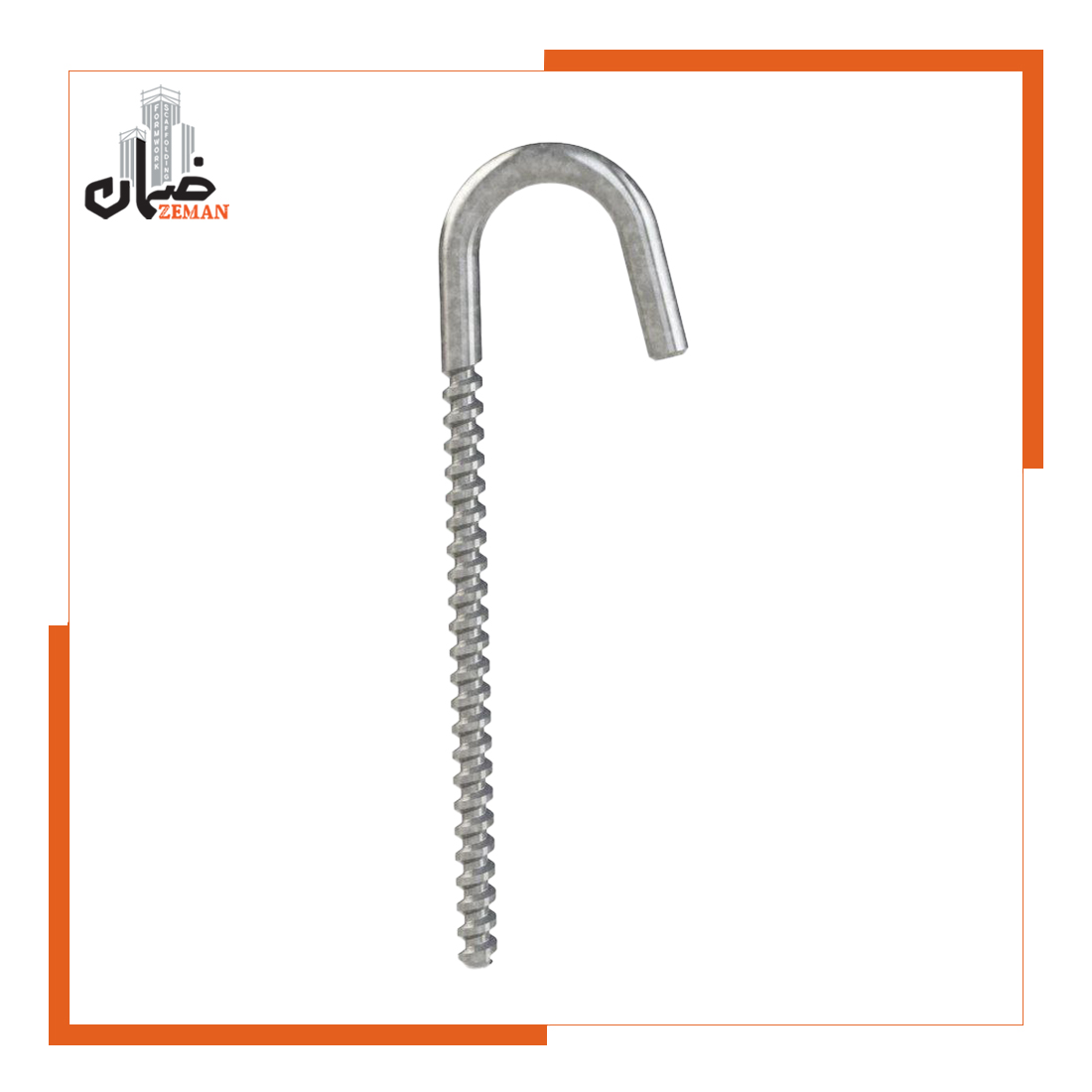
A specific type of bolt with one end bent, used in conjunction with soldiers during concrete wall formwork operations.
Advantages of using a fully threaded tie rod:
- High resistance to concrete pressure.
- Excellent adjustability due to full-length threading.
- Reusable in other projects, provided it remains undamaged.
- Suitable for various two-sided wall formwork systems.
Execution note: After the completion of concreting and the removal of the formwork, the tie rods are typically dismantled and reused in subsequent projects. In certain special applications, such as water-retaining structures, parts of the tie rod remain embedded, and water-stop or cone-type tie rods are used instead.
Cane Tie Rod
Introduction: Cane Bolt, the Backbone of Strength in Concrete Wall Bracing Systems
In the construction of concrete walls, one of the fundamental engineering challenges is managing the immense hydrostatic pressure generated by freshly poured concrete. This lateral pressure, which can reach several tons per square meter, exerts extraordinary forces on formwork panels. Failure to properly restrain these forces not only leads to panel deformation, surface irregularities, and deviation from the designed wall thickness, but in severe cases may result in catastrophic formwork failure with irreparable human and financial consequences. At the core of the external bracing system designed to counteract these forces lies a critical yet often overlooked component: the cane bolt.
The cane bolt, also known in the industry as a soldier clamp or soldier hook, is far more than a simple fastener. It serves as the vital link between vertical walers (soldiers) and horizontal walers (pipes), transferring loads from the formwork surface to the structural bracing framework. In other words, the dimensional accuracy, surface flatness, and overall safety of a concrete wall are directly dependent on the quality, strength, and proper installation of cane bolts.
This comprehensive report has been prepared as a complete technical reference for construction industry professionals, including civil engineers, project managers, site supervisors, and formwork contractors. The study begins with a detailed examination of the anatomy, technical specifications, and manufacturing process of the cane bolt, followed by an explanation of its operating mechanism and a step-by-step installation guide within formwork systems. A specialized comparative analysis then clarifies the position of this component relative to other commonly used formwork bolts. Finally, practical guidance for selecting and purchasing high-quality products is provided. The ultimate objective is to foster a deep understanding of the critical role this component plays in ensuring the stability and quality of concrete structures.
Components and Technical Specifications of the Cane Bolt: From Raw Material to Precision Manufacturing
The quality and performance of a cane bolt are directly determined by its constituent components, raw materials, and manufacturing precision. Understanding these technical characteristics is the first step in distinguishing a standard-compliant product from a substandard and potentially hazardous one.
A standard cane bolt consists of three main components, each playing a vital role in its overall performance:
- Curved Head or Hook: This section, which gives the cane bolt its name, is specifically designed to engage and lock around the horizontal bracing pipe. The geometry, curvature radius, and thickness of the hook must ensure maximum contact area with the pipe, allowing safe load transfer without slipping or permanent deformation.
- Body or Shank: This straight section is responsible for transmitting tensile forces from the soldier to the hook and subsequently to the bracing pipe. Smoothness, structural integrity, and the absence of any manufacturing defects in the shank are essential to prevent buckling or failure under load.
- Threaded Section: The end of the bolt is provided with threads onto which a wing nut is tightened. The quality of these threads plays a decisive role in connection strength. Precise and deep threads enable sufficient pre-tensioning and prevent loosening of the connection during concrete pouring and vibration.
Raw Materials and Standards
The standard raw material for manufacturing a high-quality cane bolt is industrial rebar with a diameter of 16 mm. The most commonly used steel grade is ST37, which offers an optimal balance between tensile strength, ductility, and weldability. Using lower-grade steel may result in elongation or sudden failure of the bolt under high concrete pressure.
To enhance service life and reusability—particularly in humid and corrosive job-site environments—cane bolts can be produced with a galvanized coating. This coating forms a protective zinc layer that resists corrosion and represents a more durable long-term investment for contractors.
Manufacturing Process: Where Quality Makes the Difference
The principal distinction between a high-quality cane bolt and an inferior product lies in the manufacturing process, particularly in the method used to form the threads. The most reliable and superior techniques involve CNC machining or thread rolling, which produce uniform pitch threads with precise profiles and high mechanical strength. In contrast, traditional and low-cost methods such as manual die threading can damage the steel’s molecular structure and generate weak threads prone to stripping. Quality control throughout production—including dimensional checks, thread profile inspection, and metallurgical testing of raw materials—is essential to delivering a reliable product.
Standard and Custom Dimensions
Cane bolts in the concrete formwork industry are typically manufactured in standard lengths to match common soldier and bracing system dimensions. These standard lengths include:
- 40 cm
- 50 cm
- 60 cm
The 40 cm length is the most common for general applications, while the 50 cm and 60 cm versions are used for wider soldiers or situations requiring greater installation clearance. Zeman Company not only produces and supplies all standard lengths, but also offers custom-manufactured cane bolts to meet the specific requirements of unique projects. This flexibility ensures that an engineered solution exists for every bracing system design.
Technical Specifications of Zeman Cane Bolts
| Model No. | Overall Length (cm) | Material Grade | Rebar Diameter (mm) | Thread Length (cm) | Surface Finish | Weight (kg) | Max Allowable Load (kN) |
|---|---|---|---|---|---|---|---|
| ZBC-40 | 40 | ST37 Steel | 16 | 15 | Plain | 0.65 | 35 |
| ZBC-50 | 50 | ST37 Steel | 16 | 15 | Plain | 0.80 | 35 |
| ZBC-60 | 60 | ST37 Steel | 16 | 15 | Plain | 0.95 | 35 |
| ZBC-40G | 40 | ST37 Steel | 16 | 15 | Galvanized | 0.66 | 35 |
| ZBC-50G | 50 | ST37 Steel | 16 | 15 | Galvanized | 0.81 | 35 |
| ZBC-60G | 60 | ST37 Steel | 16 | 15 | Galvanized | 0.96 | 35 |
Note: The maximum allowable loads are calculated based on engineering safety factors. Consultation with technical experts is mandatory for special applications.
Operating Mechanism and Step-by-Step Installation Guide in Formwork Systems
The proper performance of a cane bolt is meaningful only within an integrated system. This component does not function independently; rather, it serves as a mechanical interface that distributes forces among various bracing elements. Understanding this mechanism and adhering to correct installation principles are essential to achieving complete safety and structural stability.
System Role: Connecting Vertical and Horizontal Walers
In a standard wall formwork system, panels are reinforced by horizontal walers, typically made of scaffolding pipes. These walers distribute the localized pressure exerted by fresh concrete along the panel surface. To prevent the entire assembly from bending outward, however, a stronger vertical bracing framework is required—this is where soldiers come into play. Soldiers are heavy-duty double-channel profiles positioned vertically over the horizontal walers.
The critical role of the cane bolt is to create a strong mechanical connection between the soldier (vertical waler) and the pipe (horizontal waler). This connection transfers the load collected by the panels and horizontal pipes to the soldier. The soldiers then act as vertical beams, transferring the load to anchorage points at the top and bottom of the wall, such as the foundation and slab. Consequently, the cane bolt represents a key link in the load-transfer chain.
Installation Guide
The installation of a cane bolt is a fast and efficient process requiring no special tools. The installation steps are as follows:
- Step 1: Placement of Horizontal Walers: After erecting the wall formwork panels, horizontal bracing pipes are positioned at specified intervals along the formwork surface.
- Step 2: Positioning of Soldiers: Soldiers are installed vertically at engineered spacings on top of the horizontal walers.
- Step 3: Engaging the Bolt Hook: The curved hook of the cane bolt is placed from above around the horizontal waler pipe so that it fully embraces the pipe.
- Step 4: Passing the Bolt Through the Soldier: The threaded end of the bolt is passed through the designated slot or hole provided in the soldier profile.
- Step 5: Final Fixation: From the outer side of the soldier, a cup washer is first placed on the bolt, followed by tightening the wing nut manually to the maximum extent. This procedure is repeated for all soldier-to-pipe connection points.
Analysis of Complementary Components
The effectiveness of this connection also depends on two complementary components whose quality is as critical as that of the bolt itself:
- Wing Nut: The two-wing design allows workers to quickly tighten connections without requiring spanners or other tools. In large-scale projects with hundreds of connection points, this feature significantly accelerates assembly and dismantling operations.
- Cup Washer: This washer is not merely a flat metal plate. Its concave shape serves two key functions: first, it distributes the compressive force generated by tightening the nut over a wider area of the soldier edge, preventing stress concentration and profile damage; second, its curvature allows the nut to seat properly even in cases of slight misalignment, ensuring a firm and secure connection.
The key advantage of this system lies in its efficiency and speed. The simple “hook, pass through, and hand-tighten” process significantly reduces labor time. When applied over the scale of a large wall, this time saving translates directly into lower labor costs and accelerated project schedules, representing a strategic advantage for any contractor.
Key Applications and Strategic Advantages of the Cane Bolt
Thanks to its intelligent design and inherent strength, the cane bolt is widely used in various concrete construction projects and offers tangible advantages to execution teams. These benefits extend beyond simple connectivity and directly affect final structural quality, site safety, and overall project productivity.
Key Applications
- Bracing of Single-Sided and Double-Sided Walls: This is the most common application of the cane bolt. In double-sided walls, the system is applied on both faces of the formwork. In single-sided walls (such as retaining walls or walls adjacent to existing structures), the soldier-and-cane-bolt bracing system prevents outward overturning of the formwork.
- Enhancement of Formwork Rigidity and Integrity: A formwork system properly braced using soldiers and cane bolts behaves as a rigid, unified structure. This rigidity prevents deformation, distortion, or bulging of panels under concrete pressure and ensures a perfectly straight and flat finished wall.
- Ensuring Stability in Mass Concrete Pouring: In major projects such as tall shear walls, building cores, dam walls, and bridge piers, the height and volume of concrete pours are extremely high. Under such conditions, even minor weaknesses in the bracing system can lead to catastrophic failure. The cane bolt acts as a reliable connector, playing a vital role in maintaining stability and safety in these critical structures.
Strategic Advantages
Significant improvement in strength and safety: The all-steel, rigid connection created by cane bolts greatly enhances formwork resistance against dynamic forces generated by concrete pumping and vibration. This minimizes the risk of formwork failure and substantially improves overall site safety.
- Dimensional accuracy and concrete surface quality: By fully stabilizing formwork panels and preventing movement, cane-bolt-based bracing systems ensure that the finished wall is constructed exactly in accordance with the dimensions and thickness specified in design drawings. This accuracy eliminates the need for costly corrective works such as shotcreting or demolition and reconstruction, delivering smooth, high-quality exposed concrete surfaces.
- Ease and speed of installation and dismantling: As noted earlier, the rapid installation mechanism and lack of need for specialized tools significantly shorten assembly and dismantling times. This benefit directly reduces formwork cycle time and accelerates overall project progress.
- Durability and reusability: High-quality cane bolts—especially galvanized models—are designed for repeated use. After each concrete pour, they can be easily removed and reused on subsequent projects. This reusability reduces long-term equipment depreciation costs and delivers a higher return on investment for contractors.
In summary, using cane bolts represents an intelligent investment in the quality, safety, and productivity of concrete construction projects. This small component plays a major role in ensuring compliance of the final structure with engineering standards.
Specialized Comparative Analysis: Cane Bolt Versus Other Formwork Connectors
One of the main sources of confusion within the construction industry is the wide variety of bolts and connectors used in formwork systems and the lack of understanding of their functional differences. The cane bolt is part of a broader ecosystem of connectors, and its effectiveness becomes evident only when used in its proper application. To clarify this issue, a simple yet powerful analytical framework is presented below.
Analytical Framework: External Bracing vs. Internal Ties
For a wall formwork system to remain stable, two mechanisms must operate simultaneously:
- External Bracing: This system operates on the outer face of the formwork and prevents panels from bending outward. It consists of soldiers, bracing pipes, and cane bolts. These components are located outside the concrete pour and are fully removed after completion.
- Internal Ties: This system runs through the concrete pour and maintains a constant distance between the two opposing formwork faces, thereby defining wall thickness. Its main components include fully threaded tie rods and water-stopping tie systems.
With this framework, the fundamental differences between the cane bolt and other bolts become clear.
Cane Bolt vs. Fully Threaded / Double-Ended Tie Rod
- Function: The cane bolt is an external bracing device, connecting soldiers to horizontal walers. In contrast, a fully threaded tie rod is an internal connector that passes through the entire wall thickness and pulls the two formwork faces toward each other to prevent separation.
- Application: Cane bolts are always used in conjunction with soldiers. Fully threaded tie rods, used with two wing nuts and two cup washers, directly connect opposing formwork panels. To prevent bonding with concrete, they are typically installed inside plastic sleeves.
- Conclusion: These two systems are not competitors but complements. In a standard wall, both are used simultaneously: tie rods control wall thickness, while cane bolts and soldiers prevent panel bending.
Cane Bolt vs. Water-Stop Tie System
- Function: The cane bolt provides no waterproofing function. A
water-stop tie system
(available in cast iron, plastic, or spring types) is a specialized internal connector designed for waterproofing applications. In water-retaining structures such as tanks, pools, and basements, the water-stop remains embedded in the concrete after formwork removal, sealing the tie-rod path. - Application: Cane bolts are used in nearly all types of walls, whereas water-stop ties are used exclusively in waterproof structures.
Clarifying a Common Misconception: “Formwork Cane Bolt” vs. “Cane Anchor Bolt”
In some non-technical sources, these two terms are incorrectly used interchangeably, which can lead to serious procurement errors.
- Formwork Cane Bolt: A temporary component used during construction for bracing concrete formwork. After concrete curing and formwork removal, it is detached and reused in subsequent projects.
- Cane Anchor Bolt: A permanent component installed either prior to concrete pouring or post-installed in hardened concrete. Its purpose is to permanently anchor other structures—such as steel columns, machinery bases, or railings—to the concrete structure.
These two components have no functional relationship, and understanding their differences is essential for engineers and construction managers.
This analysis clearly demonstrates that each of these connectors is designed to solve a specific engineering problem, and selecting the correct one based on structural requirements is a fundamental principle of formwork engineering.
Guide to Selecting and Purchasing High-Quality Cane Bolts from Zeman Company
After understanding the technical importance and applications of the cane bolt, the final step is selecting a product capable of meeting the safety and quality standards of your project. The market contains products of varying quality levels, and an incorrect choice can negate all engineering calculations.
Quality Control Checklist
A professional contractor or supervising engineer should check the following when receiving cane bolts:
- Thread quality: Threads must be smooth, uniform, and free from damage or flattening. The wing nut should travel smoothly along the entire threaded length without excessive play.
- Body straightness and integrity: The bolt body must be perfectly straight, without bending or distortion. Its surface should be free of microcracks or discontinuities caused by poor manufacturing.
- Hook dimensional accuracy: The internal diameter of the hook must be compatible with standard bracing pipes (typically 48–50 mm scaffolding pipes). The hook must neither be overly open nor excessively tight to ensure full engagement without slippage.
- Overall build quality: The finished product should have a clean, consistent appearance. Sharp burrs, uneven surfaces, or residual welding defects indicate poor production quality.
Factors Affecting Price
The price of cane bolts is influenced by several key factors:
- Material and coating: Bolts manufactured from certified steel and particularly galvanized models are priced higher. This premium is justified by considerably longer service life and superior corrosion resistance.
- Size and weight: Longer bolts (50 cm and 60 cm) naturally cost more than 40 cm models due to increased raw material consumption.
- Market fluctuations: Steel prices, as the primary raw material, are subject to global and domestic market conditions, leading to fluctuations in final product pricing.
Why Zeman Company?
With a deep understanding of the technical and safety requirements of construction projects, Zeman Company is committed to manufacturing formwork equipment at the highest quality level. Choosing Zeman cane bolts offers the following advantages:
- Commitment to raw material quality: All Zeman cane bolts are manufactured from certified industrial rebar sourced from reputable steel producers. Raw material quality is guaranteed.
- Advanced manufacturing technology: CNC thread machining ensures precision, uniformity, and maximum strength. This commitment to technology clearly distinguishes our products from traditional alternatives.
- Specialized technical consultation: Zeman’s engineering sales team provides expert guidance to help select the most suitable equipment based on project drawings and technical requirements, delivering solutions that are both safe and cost-effective.
- Complete inventory and timely delivery: Understanding the importance of project scheduling, we maintain full stock of all standard cane bolt sizes and related connectors to meet customer demands in the shortest possible time.
Conclusion: The Strength of Your Structure Begins with Smart Connector Selection
In civil engineering, the greatest outcomes often result from attention to the smallest details. The cane bolt perfectly exemplifies this principle. Although modest when compared to the vast volumes of concrete and steel in a structure, this steel component plays a critical and irreplaceable role in the external bracing of formwork systems. As demonstrated in this report, formwork stability, dimensional accuracy, concrete surface quality, and—most importantly—site safety all depend on the correct performance of this connector.
Selecting a cane bolt is not merely a procurement decision; it is an engineering decision. The difference between a product manufactured with standard-compliant steel and precision CNC threads and an inferior alternative is the difference between a flawless wall and a job-site disaster. Investing in high-quality equipment is an investment in safety, credibility, and project efficiency.
With over three decades of experience in manufacturing and exporting concrete formwork equipment, Zeman Company considers itself not only a producer but a reliable partner for builders and engineers. Our commitment to quality, innovation, and professional consultation is dedicated to delivering strong, safe, and durable structures.
To receive expert consultation on selecting cane bolts and other formwork equipment tailored to your project requirements, and to obtain the latest pricing information, please contact Zeman Company’s technical sales team today.
Get expert advice
Our sales experts at Zaman are ready to provide guidance and advice before your purchase.

Reviews
There are no reviews yet.