



Adjustable Head Jack (Adjusting Screw)
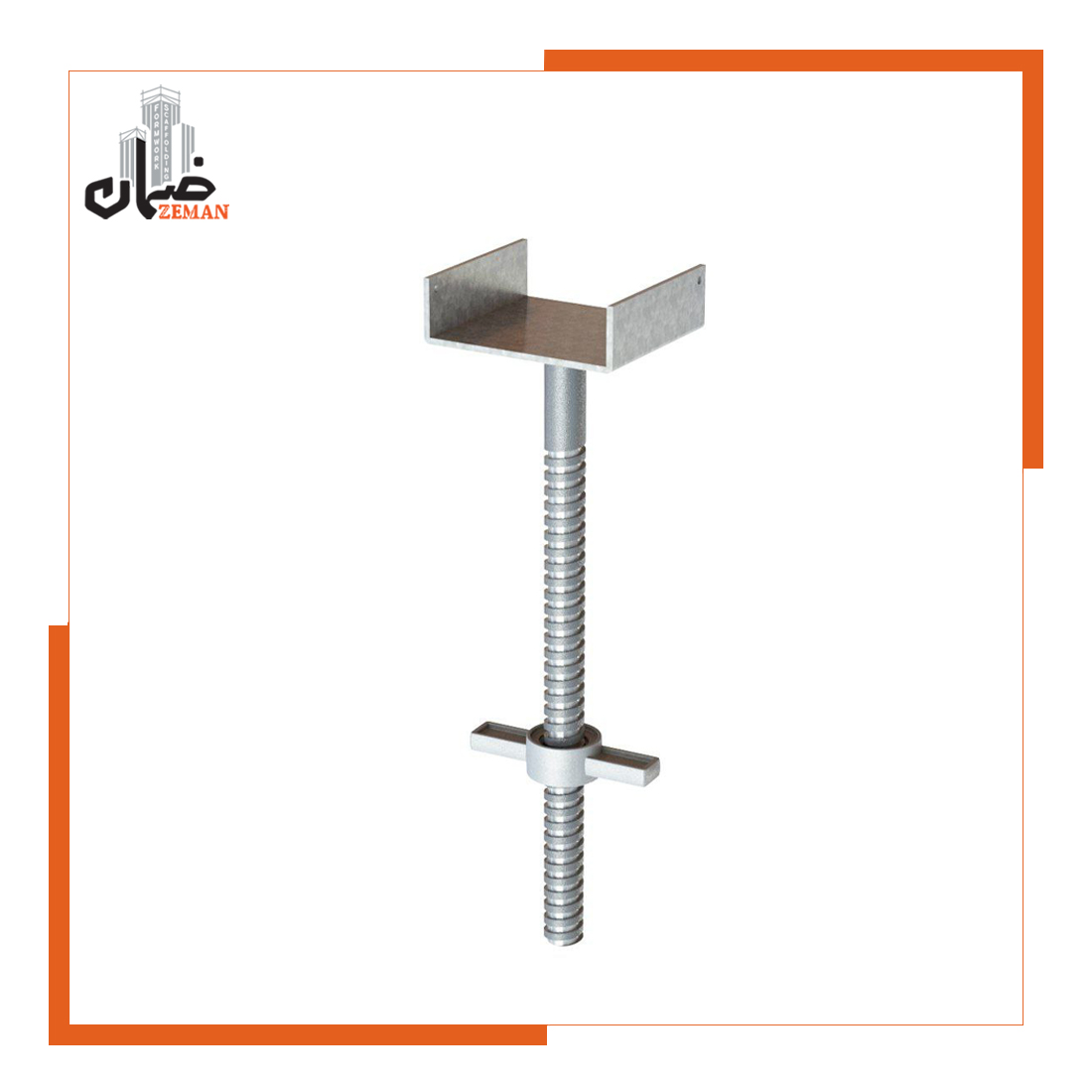
The adjusting screw is the threaded component of the adjustable base jack, designed to move up and down in a screw-like motion. By rotating the top nut, the overall height of the scaffolding system can be precisely adjusted (for example, from 40 to 80 centimeters).
The product manufactured by Beton Sazeh Zeman is equipped with a standard heavy-duty nut, allowing smoother rotation and providing a stable seating surface for the scaffolding tube. This head jack is produced using a high-strength steel bolt combined with a ductile (nodular) cast iron nut, and manufactured through fully robotic production processes to ensure maximum safety and structural integrity on site. It is available in U-head and cross-head configurations, as well as in various lengths, to meet the requirements of different projects.
Application: Installed at the lowest point of the scaffolding system to level and stabilize the entire structure; it is also widely used in concrete formwork systems for accurate adjustment and control of formwork elevation.
Adjustable Head Jack (Adjusting Screw)
Introduction: The Adjustable Head Jack — The Hidden Hero of Stable Structures
At the heart of every successful construction project lies a series of precise decisions and intelligent selections. From initial design to final execution, each component must comply with the highest standards to ensure safety, durability, and structural integrity. In this process, concrete formwork equipment and scaffolding systems play a vital role as the project’s temporary structural skeleton. One of the most critical—yet often overlooked—components is the adjustable head jack, also known as the adjusting screw. This component is responsible for precise height adjustment, uniform distribution of massive loads, and ensuring perfect leveling of formwork systems.
The quality of this seemingly simple component has a direct and undeniable impact on slab stability during concreting, project execution speed, and ultimately, worker safety. A low-quality head jack can lead to formwork settlement, concrete cracking, or even complete structural failure. Therefore, selecting an engineered head jack manufactured from premium raw materials is not a cost—rather, it is a necessary investment in project reliability and success.
Zeman Company, as one of the leading manufacturers in the Middle East and Central Asia, leverages decades of experience alongside advanced technologies and fully robotic production lines to deliver adjustable head jacks that represent precision, strength, and reliability. This comprehensive guide will help you make the optimal choice for your project with a professional and in-depth understanding.
What Is an Adjustable Head Jack?
An adjustable head jack—known by various names in the construction industry—is a mechanical device installed at the top of scaffolding systems (such as triangular scaffolding, hammer scaffolding, or cuplock systems) or on shoring props. Its primary function is to enable precise, millimeter-level final height adjustment, ensure complete leveling of the formwork surface, and safely transfer compressive loads from the main structure (such as a concrete slab) to the scaffolding system.
One Product, Multiple Industry Terms:
Familiarity with the common terminology of this component facilitates clearer communication within the construction sector:
- Adjusting Screw: Referring to its threaded structure and adjustment function.
- Adjustable / Regulating Head Jack: Emphasizing its height-adjustment capability.
- Scaffold Head Jack: Based on its primary use on modular scaffolding systems.
- Formwork Head Jack: Highlighting its key role in concrete formwork stabilization.
- Adjustable Jack Base: Another term emphasizing its height-regulation function.
Precision Anatomy of Zeman Head Jacks: Engineering for Maximum Strength
The quality of a head jack lies in its construction details and raw materials. At Zeman, every component is meticulously engineered and manufactured in accordance with strict technical standards to ensure durability and long-term reliability. A standard adjustable head jack consists of three main components:
1. Fully Threaded Bolt (Jack Core): The Load-Bearing Backbone
This core component, which bears the primary load, is manufactured from solid steel rod with a 32 mm diameter. The use of high-carbon steel maximizes compressive and tensile strength, preventing bolt bending under heavy loads. Precisely rolled, dense threads—produced using advanced machinery (40 to 100 threads per inch)—enable millimeter-level adjustment and prevent nut slippage under concrete pressure.
2. Top Plate (U-Shaped or Cross-Type): Secure Load Interface
This plate, which transfers loads from beams or formwork to the bolt, is manufactured from ST37 structural steel sheet with a standard thickness of 4 or 5 mm, ensuring resistance against bending and concentrated loads.
- ST37 Steel Standard: Equivalent to S235JR under European standard EN 10025-2 and defined by DIN 17100, this low-carbon steel offers excellent weldability and formability. It provides an optimal balance between strength (tensile strength: 360–530 MPa) and ductility, making it ideal for components subjected to compression and impact forces.
- Zeman’s Competitive Advantage – Reinforcement Gussets: Unlike many market alternatives, Zeman head jacks are equipped with four reinforcement gussets. These triangular steel plates are robotically welded to strengthen the connection between the bolt and the top plate, significantly increasing resistance to shear and bending forces.
3. Wing Nut (Claw Nut): Impact-Resistant Adjustment Mechanism
Since height adjustment mechanisms must match the strength of the bolt, Zeman head jack nuts are manufactured exclusively from ductile cast iron using precision casting methods.
Ductile Cast Iron Standard: Complying with standards such as ASTM A536 or GGG40 (German Standard), ductile iron—unlike brittle gray cast iron (GG-25)—features a nodular graphite structure that provides exceptional toughness and impact resistance. This critical characteristic ensures that the nut does not fracture suddenly under harsh site conditions or hammer impacts, thus maintaining overall system safety.
Zeman Manufacturing Process: From Raw Steel to Final Product
The superior quality of Zeman products results from a tightly controlled manufacturing process in which modern industrial technologies play a decisive role.
- Material Cutting and Preparation: Steel rods and ST37 plates are cut to precise dimensions (bolt lengths ranging from 40 to 80 cm) using CNC cutting machines to ensure dimensional accuracy.
- Precision Thread Rolling: The cut rods are processed through advanced thread-rolling machines. Deep and dense threads increase contact surface area between the nut and bolt, preventing play and slippage.
- Fully Robotic Welding: One of Zeman’s key differentiators, robotic welding ensures full penetration, uniform weld quality, and structural consistency—critical at the bolt-to-plate connection, which is a common failure point in low-quality jacks.
- Multi-Stage Quality Control: Each head jack undergoes dimensional checks, weld inspections, thread integrity verification, and random compressive load testing on production batches.
Types of Adjustable Head Jacks: Selecting the Right Model for Your Project
1. Based on Plate Shape: U-Shaped vs. Cross-Type
- U-Shaped Head Jack: Ideal for linear components such as timber beams, soldiers, and ledgers. Commonly used in triangular and hammer scaffolding systems.
- Cross-Type Head Jack: Designed with a larger contact area for uniform load distribution under concrete slabs such as flat slabs, waffle slabs, and U-Boot systems.
2. Based on Bolt Structure: Solid vs. Hollow
- Solid Head Jack: Manufactured from solid steel rods, offering maximum load-bearing capacity. Essential for heavy-duty projects such as bridges, mass concreting, and high-rise structures.
- Hollow Head Jack: Made from steel tubes, lighter and more economical, suitable for lower-load applications such as joist-and-block slabs.
Technical Specifications and Load Capacity of Zeman Head Jacks
| Zeman Product Code | Bolt Length (cm) | Approx. Weight (kg) | Bolt Type | Plate Thickness (mm) | Tested Load Capacity (tons) |
|---|---|---|---|---|---|
| Z-HJ-S40 | 40 | 5 | Solid Ø32 Steel | 5 | 10 |
| Z-HJ-S50 | 50 | 6 | Solid Ø32 Steel | 5 | 10 |
| Z-HJ-S60 | 60 | 7 | Solid Ø32 Steel | 5 | 10 |
| Z-HJ-S70 | 70 | 8 | Solid Ø32 Steel | 5 | 10 |
| Z-HJ-S80 | 80 | 9 | Solid Ø32 Steel | 5 | 10 |
Load Testing: All Zeman head jacks undergo destructive compressive load testing and have demonstrated load-bearing capacities of up to 10 tons, ensuring unmatched safety and performance.
For free technical consultation, updated pricing, and direct factory orders, contact Zeman’s sales team today. With over 100 successful national and international projects—including developments in Iraq and neighboring countries—Zeman is your trusted partner in professional formwork and scaffolding solutions.
Get expert advice
Our sales experts at Zaman are ready to provide guidance and advice before your purchase.

Reviews
There are no reviews yet.