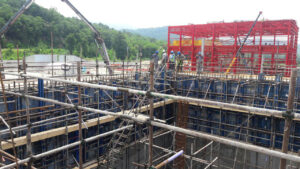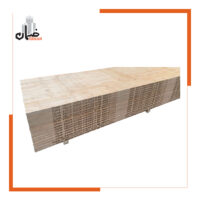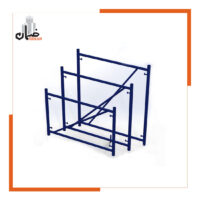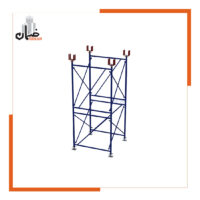



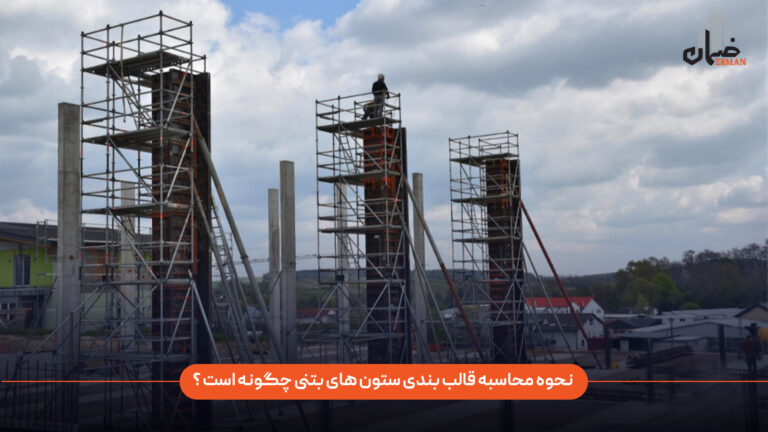
Columns, as the principal and vital members within the structural framework of any building, are responsible for transferring vertical and lateral loads from beams and slabs to the foundation. The proper and safe performance of a building heavily depends on precision in the design, fabrication, and execution of these members. In this context, column formwork is a key process that not only imparts the desired shape and dimensions to concrete but must also withstand applied pressures and ensure the final integrity of the column. Even the smallest error at this stage—such as incorrect dimensions, lack of verticality, or insufficient bracing—can lead to reduced structural strength, cracking, and ultimately jeopardize the overall stability of the building.
Accurate calculation of concrete column formwork is a dual-purpose process that addresses two critical needs in a construction project.
- First, estimating the quantity and type of equipment required for execution, which is highly important for contractors and site managers when preparing purchase or rental lists.
- Second, calculating the surface area of the formed surfaces, which is essential for clients to determine work quantities and compensate the execution team.
Ignoring either of these two aspects can lead to financial waste, project delays, and risks to life and property.
Why Is Formwork More Than a Simple Frame?
Concrete formwork performs tasks far more complex than merely creating a simple mold. The system must hold the concrete in its intended dimensions, protect it against mechanical stresses, prevent leakage of cement paste, and act as insulation against temperature variations. To accurately understand design requirements, the forces and loads applied to the formwork must be identified. The most important of these forces is the lateral pressure of fresh concrete, which, due to the fluid-like behavior of concrete prior to setting, acts on the formwork walls.

Multiple factors influence the magnitude of this pressure, and understanding their interrelationships is crucial for proper formwork design:
Concrete Placement Rate
This factor is one of the most significant variables affecting lateral pressure. Rapid, vertical placement can apply full hydrostatic pressure across the entire depth of the formwork. In contrast, a slower placement rate allows the lower layers to begin setting before completion, thereby reducing pressure on the formwork.
Concrete and Ambient Temperature
Low ambient temperatures reduce the setting rate of concrete. This causes the concrete to remain fluid for a longer period and increases the depth of hydrostatic loading, which in turn leads to higher lateral pressure. Therefore, under cold-weather conditions, this issue must be considered in formwork design.
Concrete Vibration
Using vibrators to remove air voids and compact concrete temporarily increases lateral pressure by approximately 10–20%. Internal vibration applies less pressure than external vibration; however, in all cases, the formwork must be capable of withstanding this additional load.
Slump and Concrete Mix
Slump, as an indicator of concrete workability, affects its behavior. Lower-slump concrete behaves less like a fluid and applies lower pressure on the formwork. Additionally, cement type and the use of retarding admixtures influence setting time and therefore affect the lateral pressure exerted on the formwork.
These factors do not operate independently; they form an interconnected system. For example, on a cold day, the reduced setting speed of concrete means increased pressure on the formwork. Under such conditions, either the placement rate must be reduced or a system with stronger walers and bracing must be used to prevent formwork failure.
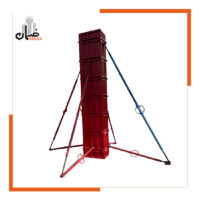
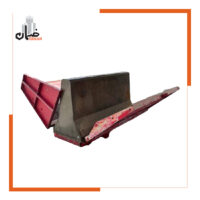
Main components of modular steel column formwork systems include:
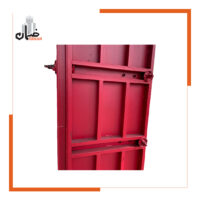
- Form panels: Flat steel sheets with reinforced edges, available in various dimensions (widths from 10 to 50 cm and lengths from 1 to 2 m).
- Corners and angles: Elements used to connect formwork corners. Corners are available in dimensions such as 5×5, 5×10, and 10×10 cm.
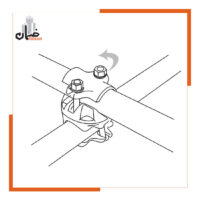
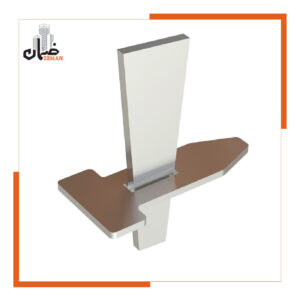
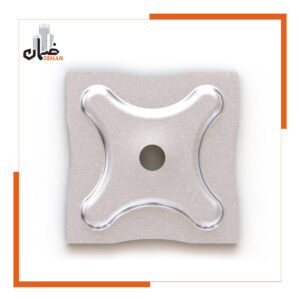
- Pin and wedge, clamps, and bolt nuts: Mechanical connectors used to fasten panels and corners together.
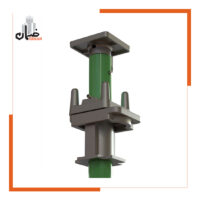
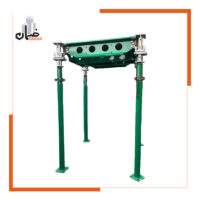
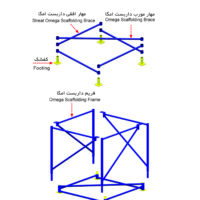
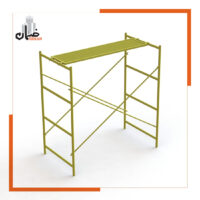
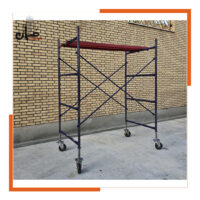
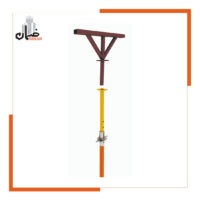
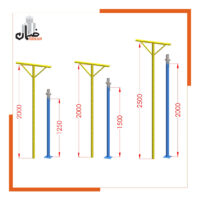
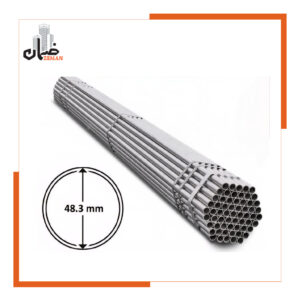
- Walers and bracing: Reinforcing elements such as scaffolding pipes and clamps that attach to the formwork to prevent deformation and loss of verticality.
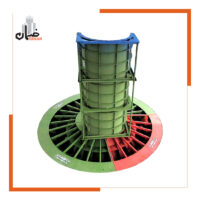
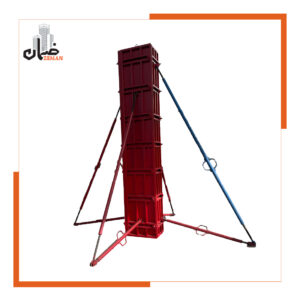
ZEMAX Variable Column Formwork: An Innovative Solution for Variable Cross-Section Columns
In complex construction projects where columns require changes in cross-section across different floors (such as gradual dimension reduction for load optimization or architectural aesthetics), the use of adjustable formwork systems is essential. The ZEMAX Variable Column Formwork, a product of Zemanco, is a modern modular system that enables execution of reinforced concrete columns with variable square or rectangular cross-sections without the need to add or remove panels at each stage. This system is designed for cross-sections from 30×30 cm to 120×120 cm, and changes in cross-section should not exceed 5 cm per floor to maintain stability.
ZEMAX Variable Column Formwork
Methods for Calculating Column Formwork (From Formula to Bill of Materials)
Column formwork calculation is divided into two main parts, each with a different application in project management.
1. Calculating Formwork Area (for Cost Estimation)
This type of calculation is used to determine labor wages and estimate the final project costs. The formwork area of a column equals its lateral surface area, obtained by multiplying the perimeter of the column cross-section by its height.
- Square or rectangular columns: Formwork area is obtained using the formula (2 × (length + width) × height).
- Circular columns: Formwork area is obtained using the formula (π × diameter × height).
For example, for a square column of 40×40 cm with a height of 3 m, the formwork area equals:
2 × (0.4 + 0.4) × 3 = 4.8 m²
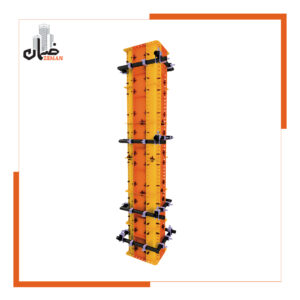
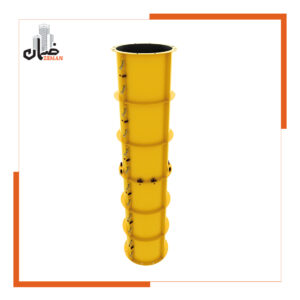
Square or Rectangular Column Formwork
2. Calculating the Number and Dimensions of Panels and Accessories (for Material Estimation)
This section is the most critical for procurement of project equipment, and instead of calculating area, it provides an estimate of the required number of panels and corners. For a column with specific dimensions, various combinations of panels and corners can be used—this flexibility allows the contractor to choose the most optimal option based on warehouse inventory, price, and desired execution speed.
The table below presents several practical estimates for formwork of square columns with a height of 3 meters:
| Column Dimensions (m) | Panel Combination (dimensions and quantity) | Corner or Zero Angle Combination (dimensions and quantity) |
| 30 × 30 | 12 panels of 15 × 100 cm | 8 corners of 5 × 10 × 150 cm |
| 12 panels of 20 × 100 cm | 8 corners of 5 × 5 × 150 cm | |
| 12 panels of 30 × 100 cm | 8 zero angle pieces of 1.5 m | |
| 35 × 35 | 12 panels of 20 × 100 cm | 8 corners of 5 × 10 × 150 cm |
| 12 panels of 25 × 100 cm | 8 corners of 5 × 5 × 150 cm | |
| 12 panels of 35 × 100 cm | 8 zero angle pieces of 1.5 m | |
| 40 × 40 | 12 panels of 25 × 100 cm | 8 corners of 5 × 10 × 150 cm |
| 12 panels of 30 × 100 cm | 8 corners of 5 × 5 × 150 cm | |
| 12 panels of 40 × 100 cm | 8 zero angle pieces of 1.5 m |
Estimating the Required Concrete Volume for Column Formwork
Accurate calculation of the required concrete volume is also part of the planning process, helping to prevent material waste, better manage costs, and optimize project scheduling.
- Square or rectangular column formwork: Concrete volume equals (length × width × height).
- Round column formwork: Concrete volume equals (π × radius² × height).
Step-by-Step Execution of Column Formwork
Proper execution of column formwork is a process that requires precision and adherence to step-by-step procedures.

Review of Drawings and Initial Preparation
Before any action, thorough review of the execution drawings to determine the exact dimensions of the columns is essential. Then, kickers (squares with the column dimensions) are installed to precisely define the column locations and prevent loss of verticality and displacement.
Cleaning and Oiling the Forms
Steel form panels must be completely cleaned before installation and uniformly coated with release agents (form oil). This prevents concrete from adhering to the form and avoids damage to it.
Assembly and Installation of Forms
Forms, as separate panels, are connected together using pin and wedge. The assembled form set is then positioned on the kicker and installed.
Bracing and Final Control
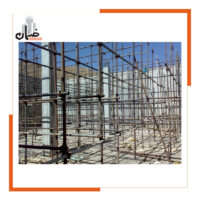
After installing the forms, walers, scaffolding pipes, clamps, and jacks are used to increase the system’s resistance and stability against lateral concrete pressures. Finally, using a plumb line and diagonal bracing, precise vertical alignment of the column is ensured. Final inspections must be carried out before and during concreting to identify and correct any errors.
Common Errors in Column Formwork Calculation and Prevention Methods
Execution errors in column formwork often have hidden consequences that may not be visible on the surface of the project but significantly affect the strength and service life of the structure. Understanding the causes of these errors and their consequences is crucial for prevention.
- Lack of Column Verticality: Failure to keep the column vertical due to inadequate bracing. This error drives structural behavior from linear to nonlinear and threatens stability. If the lack of verticality is minor, it can be corrected with specialized jacks.
- Cement Paste Leakage: This error, usually caused by open joints between form panels, reduces concrete strength and, most importantly, leads to reinforcement corrosion. Using frog clamps and sealing joints carefully with adhesive or foam can prevent this issue.
- Premature Formwork Stripping: Carried out before the concrete has achieved sufficient strength. Early stripping can damage the concrete and result in undesirable deformations or future strength problems.
- Failure to Use Release Agents: Not using or improper use of form oil causes concrete to adhere to the form, making removal difficult and damaging the final concrete surface.
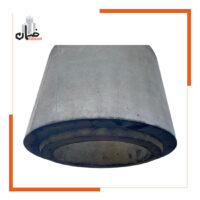
In concrete projects, selecting the appropriate column must be accompanied by attention to precast foundations so that the structure performs satisfactorily in terms of load bearing and durability.
Table of Common Errors, Causes, and Consequences
| Error Title | Cause of Error | Hidden Consequences | Preventive Measures |
| Lack of Column Verticality | Inadequate bracing, failure to use kickers, formwork displacement | Reduced structural stability, development of secondary moments, change of behavior towards nonlinearity | Adequate bracing with scaffolding pipes and clamps, use of plumb line, continuous inspection |
| Cement Paste Leakage | Open joints between panels, loose connections | Reduced concrete strength, reinforcement corrosion, honeycombed surfaces | Careful joint sealing, use of frog clamps and bolt nuts |
| Premature Formwork Stripping | Haste in the project, disregard for concrete strength | Deformation and concrete failure, reduced final strength | Wait until concrete reaches sufficient strength, consult the supervising engineer |
| Failure to Oil the Form | Negligence or use of low-quality materials | Concrete adherence to the form, damage to the final concrete surface, form deterioration | Use high-quality release agents and apply evenly |
Safety in Concrete Column Formwork: An Essential Step for Every Project
Observing safety principles in formwork prevents injuries to personnel and damage to equipment, and reduces incidental costs. Major hazards include working at height, electric shock, and risks associated with manual handling of forms.
- Working at Height Safety: When installing formwork at height, the stability of scaffolds and work platforms must be ensured. Additionally, installing guardrails and using appropriate lifting gear for moving materials is essential.
- Electrical Safety: Before starting welding and electrical work, all metal components must be grounded. Furthermore, during concreting with pumps or vibrators, access to electrical equipment must be shielded, and appropriate warning signs must be installed.
- Technical Inspection: Continuous and careful inspection of the forms before and during concreting is essential. This inspection must verify the stability of connections, pins and wedges, wing nuts, and clamps to ensure there are no fractures or corrosion.
Modern Tools and Software: From Online Calculators to 3D Modeling
Technological advancements have provided new tools to increase accuracy and efficiency in the formwork process.
Online Calculators
These tools allow contractors and engineers to quickly and accurately calculate the required concrete volume by entering column dimensions, thereby preventing material waste and potential errors.
Specialized Engineering Software
Today, engineers use advanced software to design, analyze, and model structures. These programs go beyond simple computation tools and enable precise formwork design and execution detailing.
- ETABS and SAP2000: Used for analysis of tall and complex structures and for studying their behavior under static and dynamic loads (such as earthquakes and wind).
- Revit and Tekla Structures: These applications enable engineers to create accurate 3D models of structures, including formwork details. These capabilities play a key role in Building Information Modeling (BIM), providing an integrated project view and minimizing execution errors.
The use of these modern tools signifies a shift in the construction industry—from traditional methods towards a digital and intelligent process that simultaneously enhances accuracy, speed, and safety.
Conclusion on Concrete Column Formwork: An Intelligent Choice for Reliable Execution
Column formwork calculation is a comprehensive process that starts from engineering fundamentals and design principles and extends to execution stages and the use of modern technologies. A successful project requires a deep understanding of formwork loads, proper equipment selection, strict adherence to execution procedures, and smart prevention of common errors.
Given the critical role of columns in structural stability, selecting high-quality forms and equipment that can withstand concrete pressures while maintaining the precise dimensions and position of the column is of paramount importance. The use of durable modular steel formwork, which allows for reusability and fast execution, is an intelligent choice to reduce costs and ensure quality. Ultimately, consulting specialists and leveraging modern computational tools help executors and clients carry out the formwork process with complete accuracy and confidence.