




One-Sided Wall Formwork
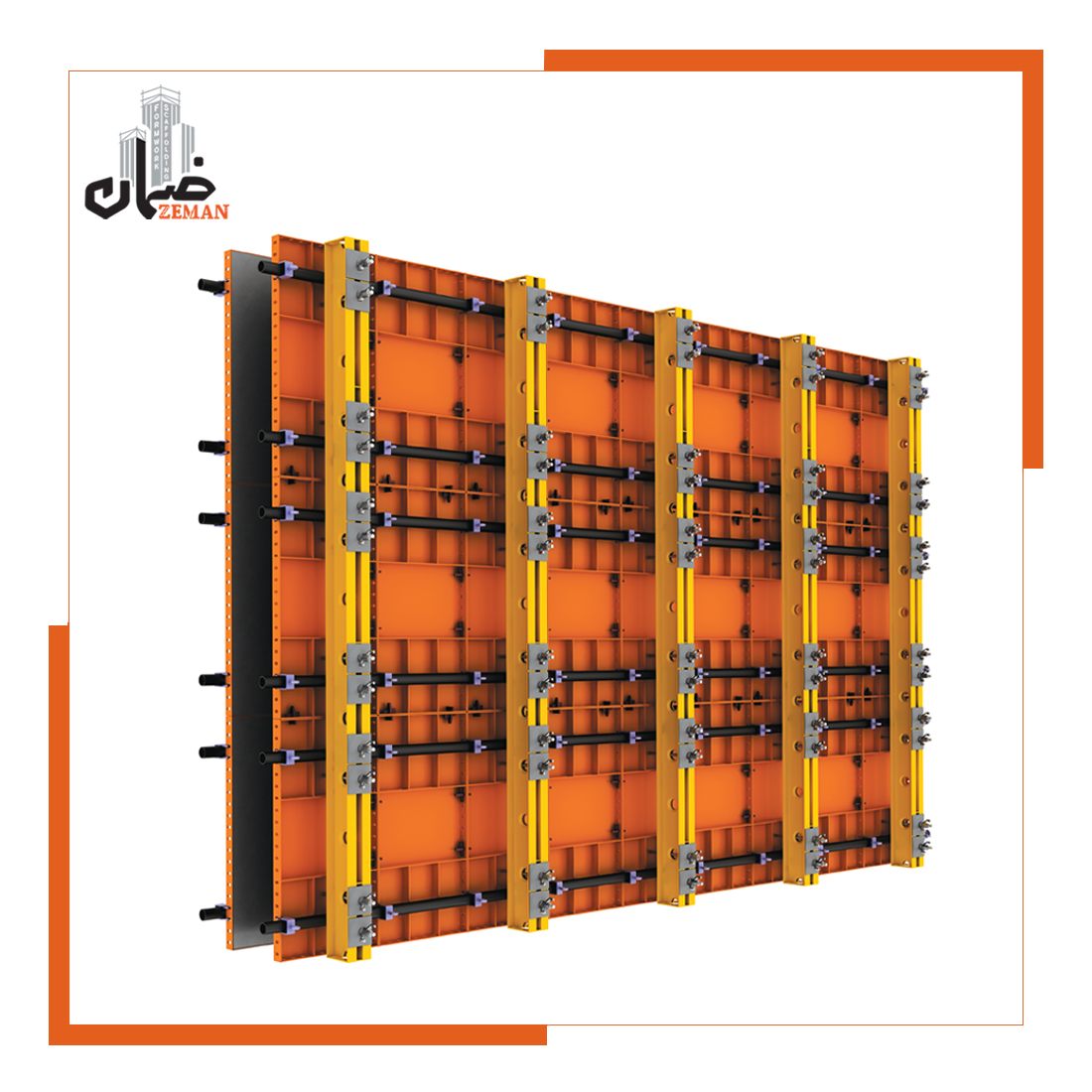
One-sided wall formwork is a critical stage in the formwork execution of construction projects and plays a highly significant role in achieving structural stability and accuracy. This method is employed when access to the opposite side of the wall is impossible or when double-sided formwork is neither required nor feasible.
In this system, the wall formwork panels are assembled into a rigid, integrated unit, while the formwork bracing and support elements are installed on the rear side of the panels. Due to the inability to use through-tie rods (formwork bolts) for wall restraint, plumbing jacks and soldier members are typically utilized to control alignment and transfer loads. The use of proper bracing in one-sided wall formwork significantly enhances the stability and safety of the formed surfaces. In essence, the quality of the connections and the precision of execution at this stage are decisive factors in ensuring the final strength, stability, and structural integrity of the wall.
One-Sided Wall Formwork
Overcoming Geometric Constraints: The Engineering Necessity of One-Sided Wall Formwork
In modern civil engineering, concrete—being a fluid and highly formable material prior to final setting—requires a temporary or permanent framework to retain and shape it. The quality and precision of this framework, known as formwork, directly affect the strength, durability, and final appearance of the concrete structure.
Under conventional conditions, wall formwork is executed using two parallel panels placed on both sides of the wall and connected by through-ties. This method evenly distributes the hydrostatic pressure of fresh concrete between the two faces. However, contemporary construction projects—particularly in dense urban environments and complex infrastructural works—present engineers with challenges in which access to both sides of the wall is physically impossible.
Such limitations arise in specific scenarios: construction of retaining walls in deep excavations adjacent to existing structures or earth-retaining systems (such as diaphragm walls or soldier piles), concreting dam bodies against rock abutments, or execution of tunnel walls in underground construction methods. In these cases, the use of a double-sided formwork system is physically unfeasible, and traditional methods lose their effectiveness. This is where the need for an advanced engineering solution—namely, the One-Sided Wall Formwork System—emerges not as an option, but as an absolute necessity.
The rapid growth of urban density and the execution of large-scale infrastructure projects have significantly increased demand for solutions capable of operating with unilateral access. Deeper excavations near property boundaries, construction of metro stations, and execution of complex shear walls all require a system capable of transferring the full concrete pressure from one side to an internal support structure.
This technical report serves as a comprehensive reference for engineers, contractors, and construction project managers, providing an in-depth analysis of the principles, components, design methodologies, and execution procedures of the one-sided wall formwork system. The objective of this guide is to deliver the technical knowledge required to fully understand the system mechanism and to introduce the advanced, engineered solutions developed by Zaman Company to address the most complex construction challenges.
Fundamental Principles and Strategic Applications of One-Sided Wall Formwork
Engineering Definition: Load Transfer Without a Counter-Support
A one-sided wall formwork system is a fully engineered assembly designed to resist the lateral pressure of fresh concrete where bracing from the opposite face of the wall is not possible. The fundamental principle of this system is based on transferring all hydrostatic loads from the formwork surface to a stable supporting structure behind it. In this mechanism, the entire formwork system behaves like a cantilever beam rigidly anchored at its base to a resistant structure—typically the foundation or a floor slab.
Load transfer path in this system is as follows:
- Fresh concrete pressure: Fluid concrete applies increasing lateral pressure to the internal surface of the formwork panels.
- Form panels: This pressure is absorbed by the panels and transferred to horizontal walers and vertical soldiers.
- Reinforcing members: These elements concentrate and transmit the load to the support brackets.
- Support brackets: Acting as the primary load-bearing components, these brackets transfer immense tensile and compressive forces to the anchorage system.
- Anchorage system: Finally, the entire load is resisted by anchors embedded in the foundation or the hardened underlying concrete structure.
This load transfer mechanism bears similarities to other specialized formwork systems such as climbing formwork and slip formwork, where loads are also transferred through anchorage into previously hardened concrete rather than conventional counter-supports. A precise understanding of this load path is critical for the safe and efficient design of the system.
Comparative Analysis: One-Sided Wall Formwork vs. Conventional Double-Sided Systems
To better understand the unique characteristics of one-sided systems, a comparison with conventional double-sided formwork is essential. While the initial cost of one-sided system components is higher due to heavy-duty brackets and robust anchorage requirements, the system enables projects that would otherwise be impossible—ultimately delivering overall time and cost savings.
Comparison of One-Sided and Double-Sided Wall Formwork Systems
| Feature | Double-Sided Formwork System (Conventional) | One-Sided Formwork System (Specialized) |
| Load Transfer Mechanism | Concrete pressure is balanced between two panels via through-ties. | All concrete pressure is transferred unilaterally to brackets and the anchorage system. |
| Key Components | Panels, walers, through-ties (tie rods), washers. | Panels, walers, support brackets, plumbing jacks, anchorage system (chemical or mechanical anchors). |
| Foundation Requirements | No special foundation design required. | Foundation or base slab must be designed to resist significant tensile and shear forces induced by anchors. |
| Installation Complexity | Fast and simple installation under full-access conditions. | Requires high precision, detailed engineering calculations, and heavier lifting equipment. |
| Cost Profile | Lower initial component cost. | Higher initial cost for brackets and anchors, but reduced overall project cost in special applications. |
| Ideal Applications | Standard walls, columns, and elements accessible from both sides. | Retaining walls, dam walls, tunnels, elevator shafts, and underground structures. |
Critical Applications: When Is One-Sided Formwork the Only Solution?
The use of one-sided formwork systems is not merely a choice but an engineering necessity in the following cases:
Retaining Walls and Earth-Retaining Structures
In deep urban excavations, permanent structural walls must be constructed against stabilization systems such as diaphragm walls, secant piles, contiguous piles, or sheet piling. In such cases, there is no physical space to install external formwork.
Dam Walls and Reservoir Structures
In gravity or arch concrete dams, mass concreting is carried out against rock abutments or previously cast concrete. The use of through-ties in such structures is prohibited or severely limited due to potential leakage paths and compromise of structural integrity. One-sided systems allow the execution of thick, monolithic walls.
Tunnels and Underground Structures
In tunnel construction methods such as cut-and-cover, tunnel walls are cast adjacent to soil or retaining structures. This system is also widely used in metro stations and underground facilities.
Deep Foundations and Elevator Shafts
When constructing foundation walls or elevator shafts with one face in direct contact with stabilized soil or rock, one-sided formwork is the only feasible option.
Architecturally Constrained Shear Walls
In certain complex architectural designs, access to the external face of a shear wall may be restricted due to adjacent structural elements, necessitating the use of this system.
The decision to adopt a one-sided wall formwork system is a strategic one with far-reaching implications for the entire project and must be made at early design stages. This choice directly affects foundation engineering, as the foundation or base slab must act not only as a gravity-load-bearing element but also as a counterweight and robust anchoring point to resist immense overturning forces generated by the formwork. This requires special design considerations, increased slab thickness, and reinforced anchorage zones. Accordingly, engaging a specialized supplier such as Zaman Company from the initial design phase can significantly optimize the structure and prevent future execution challenges.
Get expert advice
Our sales experts at Zaman are ready to provide guidance and advice before your purchase.

Reviews
There are no reviews yet.