




Scaffolding Casters
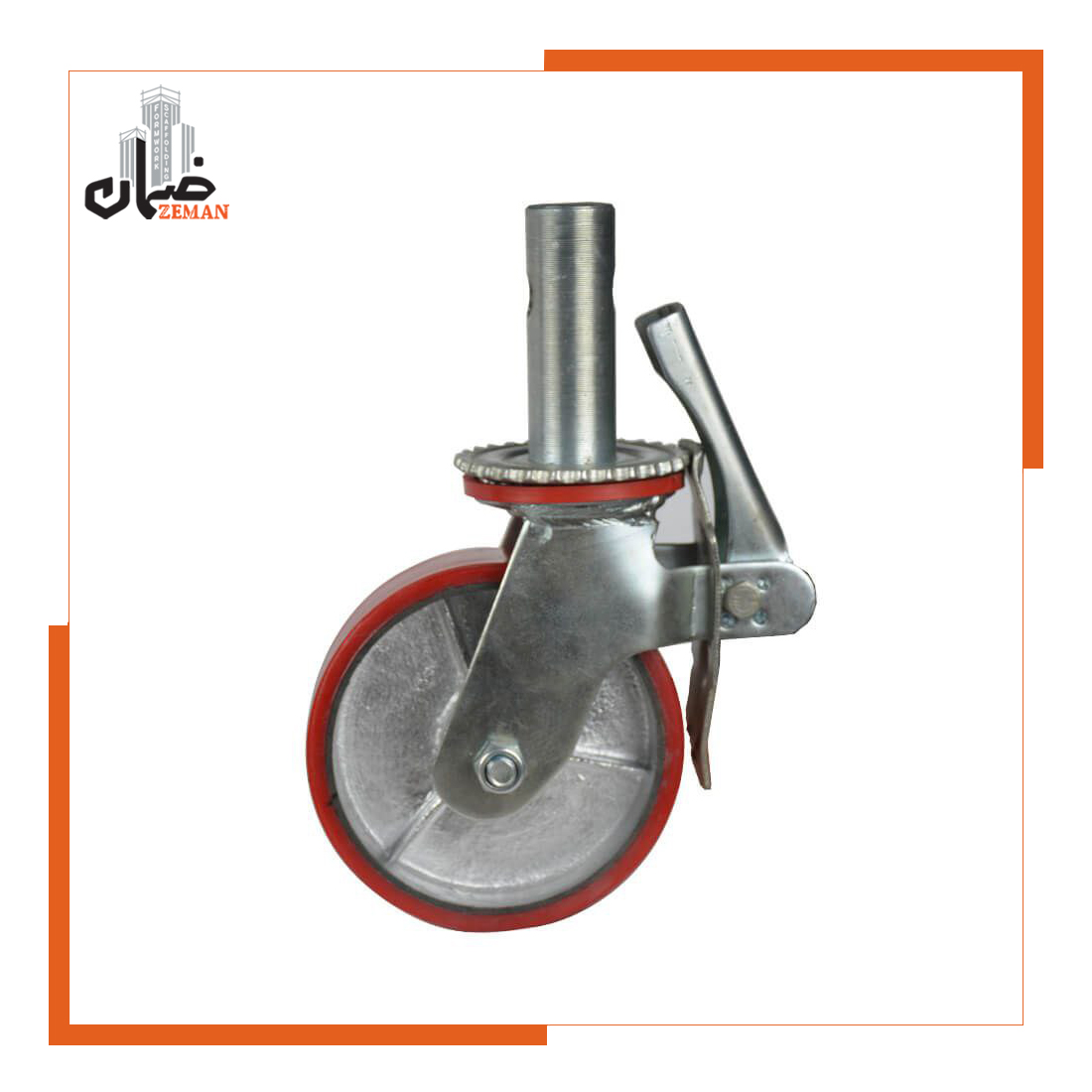
The braked scaffolding caster wheel (Caster Wheel with Brake) is a key component of mobile scaffolding systems. It is used to enable smooth and effortless movement of the scaffold while also allowing the structure to be securely locked and stabilized at the desired position during operation.
Features of Braked Scaffolding Caster Wheels:
- Lockable braking system: Typically activated by a foot pedal or lever. The brake locks both the wheel rotation and the swivel movement, preventing any unintended displacement of the scaffold.
- Body material: Usually manufactured from high-strength steel or aluminum and protected with an anti-corrosion coating for extended service life.
- Wheel material: Polyurethane (PU), hard plastic, or industrial rubber; designed to be wear-resistant and resistant to chemicals and oils.
- Load capacity: Depending on the caster type, load capacity typically ranges from 200 to 1,000 kg (or higher). The rated capacity is usually indicated on the caster body or in the product technical datasheet.
- Wheel diameter: Starting from 6 inches (150 mm) and above; larger diameters provide smoother rolling performance and improved maneuverability.
- Connection to scaffolding: Installed either via a threaded stem (screw type) or a pin-type connection. Many models also feature height adjustment capability.
Application: Used in mobile (rolling) scaffolding systems for indoor projects, warehouses, and façade works. Suitable for smooth and level surfaces such as industrial floors, tiled surfaces, and finished concrete slabs.
Scaffolding Casters
Zeman Scaffolding Casters: A Modern Solution for Mobile Scaffolding Systems
In today’s modern construction industry, speed, safety, and efficiency are of paramount importance. Zeman Company, as one of the leading manufacturers of concrete formwork equipment and steel scaffolding in the Middle East, delivers these values by leveraging advanced manufacturing technologies. Zeman scaffolding casters are far more than simple accessories; as an integral component of the company’s advanced, fully robotic scaffolding systems, they ensure enhanced safety and operational efficiency across your projects.
Zeman’s proven track record in outperforming international competitors in the Iraqi market stands as clear evidence of the exceptional quality of its products. This success is driven by technical expertise, continuous innovation, and the exclusive use of fully robotic welding technology in the production of Cuplock scaffolding and H-frame systems—a level of manufacturing precision unmatched in Iran. Zeman scaffolding casters are engineered with the same philosophy, ensuring full compatibility with the highest quality standards and serving as the ideal complement to Zeman’s high-load-capacity scaffolding systems.
Why Do You Need Scaffolding Casters? Key Product Benefits
The use of scaffolding casters has transformed working methods in construction, maintenance, and even event operations. By converting fixed scaffolding into mobile structures, these casters offer numerous advantages for contractors and workers alike:
- Significantly improved mobility and speed: Scaffolding casters enable fast and effortless relocation of the structure, eliminating the time-consuming process of dismantling and reassembling scaffolding. This allows workers to move quickly within the job site while maximizing productivity with minimal labor and downtime.
- Easy maneuverability on various surfaces: The robust design of Zeman casters allows smooth movement over uneven surfaces such as concrete floors, gravel, and construction debris without compromising structural stability.
- Wide range of applications: Scaffolding casters are widely used in indoor and outdoor construction projects including painting, electrical works, and façade installation, as well as maintenance, renovation, and event setups for lighting and sound systems.
- Enhanced on-site safety: Brake-equipped casters feature a reliable locking mechanism that prevents unintended movement, ensuring structural stability and a safe working environment during operations.
Technical Specifications and Types of Zeman Scaffolding Casters
At Zeman, we manufacture a wide range of scaffolding casters with diverse technical specifications to precisely meet the requirements of different projects. Our products are available in two main types with various tread materials:
- Swivel scaffolding caster: These casters provide full 360-degree rotation, making them ideal for fast movement and easy maneuvering of scaffolding in open or confined workspaces.
- Scaffolding caster with brake: Similar to swivel casters in terms of rotation, these models are equipped with an additional braking pedal that locks the wheel in place when required, keeping the scaffolding completely stable and secure during work.
Technical Specification Table – Zeman Scaffolding Casters
| Technical Parameter | Specification Range |
|---|---|
| Wheel Diameter (mm) | 150, 160, 200, 250 |
| Load Capacity (kg) | Variable by model, ranging from 350 to 1,000 kg |
| Tread Material | Polyurethane (PU) and Rubber |
| Base Composition | Steel and Die-Cast Iron |
Guide to Tread Selection: Polyurethane vs. Rubber
Selecting the appropriate caster tread depends on several factors, including the operating environment, expected loads, and project budget. Each material offers distinct advantages and limitations:
Polyurethane (PU):
- Advantages: Exceptional durability, excellent resistance to abrasion and tearing, and strong resistance to oils and chemicals, making it ideal for demanding industrial environments.
- Disadvantages: Typically more expensive than rubber and less effective in vibration and noise absorption.
Rubber:
- Advantages: Quiet operation, high vibration absorption, and improved grip on various surfaces. Generally lower production cost.
- Disadvantages: Faster wear under harsh conditions and potential cracking when exposed to oils or prolonged moisture.
Zeman’s Competitive Advantage: Integrated and Specialized Manufacturing
While many companies act as general suppliers of industrial casters, Zeman manufactures scaffolding casters as a critical component of a fully integrated system. Our greatest strength lies in the ability to produce Cuplock and H-frame scaffolding systems using fully robotic welding technology, delivering unmatched accuracy, consistency, and structural reliability while minimizing human error.
This integrated approach ensures that Zeman scaffolding casters are not only mechanically sound but also perfectly aligned with the performance characteristics of our scaffolding systems. This unique value proposition cannot be offered by generic competitors. Professional contractors seeking high-quality scaffolding casters are often also in need of reliable scaffolding systems; by positioning casters as an integral system component, Zeman leverages its technical credibility and manufacturing capacity to deliver superior solutions.
Safety First: Proper Usage Guidelines
Scaffolding casters must be used in strict accordance with established safety protocols. At Zeman, customer safety is our highest priority. We strongly recommend adhering to the following guidelines at all times:
- Regular inspection and maintenance: All moving components, including casters and couplers, must be periodically inspected and lubricated—especially before each use—to ensure proper performance.
- Engage the brakes: Always lock the caster brakes before workers access the scaffolding to prevent unintended movement.
- No movement during use: Never relocate mobile scaffolding while personnel are on the platform.
- Height-to-base ratio compliance: For mobile scaffolding, the height-to-base width ratio must not exceed 3:1. For heights exceeding 9.6 meters, the structure must be properly tied or braced to ensure stability.
- Proper foundation: Never place scaffolding bases on unstable objects such as bricks, boxes, or excavated pits.
Frequently Asked Questions About Scaffolding Casters
In this section, we address the most frequently asked questions regarding scaffolding casters to help you make a confident and efficient choice for your project.
1. How many casters are required for a scaffolding structure?
The required number of casters depends on the size and type of the scaffolding. For example, a 3 × 3-meter scaffold with a height of 6 meters typically requires four casters.
2. What is the difference between die-cast and cast-iron scaffolding casters?
Die casting is a high-pressure casting process that produces casters with superior strength and extended service life. Cast-iron casters are also extremely robust and offer high resistance to pressure, impact, and wear. Die-cast casters generally provide higher load-bearing capacity and outperform cast-iron models in demanding industrial environments.
3. Are Zeman scaffolding casters compatible with other scaffolding systems?
Zeman scaffolding casters are specifically designed for full compatibility with the company’s Cuplock and H-frame scaffolding systems and are classified as dedicated scaffolding accessories. However, due to compliance with industrial standards, they may also be compatible with other scaffolding systems. For confirmation, we recommend consulting our technical specialists prior to purchase.
4. What are the typical applications of scaffolding casters?
Scaffolding casters are used in a wide range of applications, including painting works, façade installation, building maintenance and renovation, as well as equipment installation for events and exhibitions.
Conclusion
Zeman scaffolding casters represent a unique combination of quality, safety, and performance, distinguished by advanced manufacturing technologies and deep industry expertise. This product not only facilitates effortless relocation of scaffolding structures but also prioritizes stability and worker safety, making it a comprehensive solution for professional projects. By choosing Zeman, you select a reliable partner committed to delivering high-quality products and ensuring the success and safety of your projects.
Get expert advice
Our sales experts at Zaman are ready to provide guidance and advice before your purchase.

Reviews
There are no reviews yet.