



Metal Scaffolding Planks
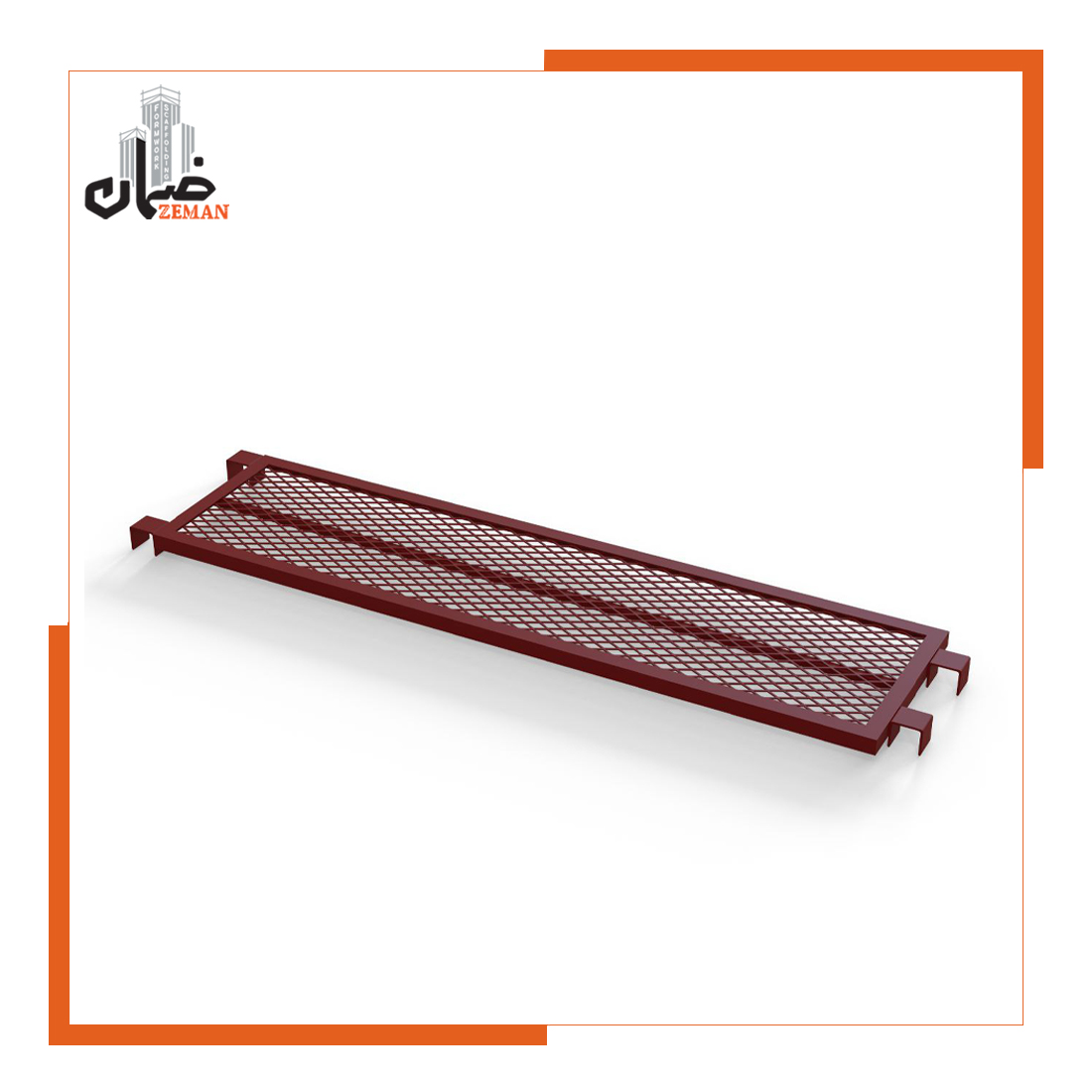
The metal scaffolding plank, also known as a steel scaffold board, is a critical component of scaffolding systems. It is installed as a safe standing surface or access walkway for workers operating on scaffolding structures.
Unlike traditional wooden planks, this type of platform is manufactured from galvanized sheet steel or rolled steel and features a serrated or perforated surface to provide enhanced safety, durability, and load resistance.
Structural Features of the Metal Scaffolding Plank
- Material: Galvanized steel or hot-rolled steel
- Length: Typically ranging from 1 to 4 meters
- Standard width: Approximately 24 to 30 cm
- Surface: Serrated or perforated to prevent slipping
- Edges: Formed and reinforced edges to improve strength and edge safety
Application: Provides a safe working surface for personnel on scaffolding; widely used in construction, industrial, refinery, maintenance, and infrastructure projects. It serves as a long-lasting replacement for traditional wooden boards with a significantly longer service life.
Advantages of Metal Planks over Wooden Boards: Enhanced safety, anti-slip working surface, fire resistance, high durability, resistance to rot, moisture, and impact; reusable for multiple cycles without deformation; low maintenance with minimal repair requirements; and full compliance with international safety standards, making them especially suitable for industrial and infrastructure projects.
Installation Method: Installed on horizontal scaffold members, H-frame scaffolding, or scaffold tubes. The plank is securely fixed to tubes or frames using side hooks or locking mechanisms, allowing for quick installation, easy adjustment, and rapid repositioning.
Available Types:
- Solid steel plank without perforations, suitable for dry environments
- Perforated steel plank designed for water drainage and increased surface friction
- Steel plank with side hooks (Hooked Plank), which locks onto scaffold tubes for enhanced safety
Metal Scaffolding Planks
Introduction: Metal Scaffolding Planks — A Modern Platform for Safety and Efficiency at Height
In today’s fast-paced construction, industrial, and infrastructure projects, scaffolding serves as a critical support system and plays a fundamental role in ensuring workplace safety at height. This temporary structure represents the backbone of every project, with its performance and integrity directly linked to worker safety and productivity. Among the many components of a scaffolding system, the working platform—or scaffolding plank—plays a role far beyond that of a simple standing surface.
The working platform is the point of direct contact between the worker and the structure and serves as the first line of defense against fall-related accidents. The primary purpose of scaffolding is to provide “a safe working area and secure access,” a goal that cannot be achieved without a standard-compliant and reliable work platform.
Zeman Company, with a deep understanding of safety requirements and the evolving needs of the construction industry, introduces its metal scaffolding plank as a highly efficient, safe, and cost-effective alternative to traditional wooden boards. This product is the result of combining up-to-date engineering knowledge, high-quality raw materials, and strict adherence to national and international standards—enhancing safety while significantly reducing hidden project costs and proving its long-term economic value.
From Wood to Steel: Why Metal Planks Are a Smart Choice
Selecting scaffolding equipment goes far beyond comparing initial purchase prices; it requires a comprehensive analysis of advantages and disadvantages throughout the entire project life cycle. In this context, metal scaffolding planks offer substantial technical and economic advantages over traditional wooden boards. These benefits are directly associated with reduced accident rates and increased workforce productivity.
An analysis of site accident data shows that many scaffolding-related incidents result from slipping or breakage of wooden working boards. Due to the natural characteristics of wood, these boards deteriorate over time, becoming prone to decay, deformation, and wear. Factors such as moisture, sunlight, and variable loads can cause warping, cracking, or even sudden failure.
Additionally, insufficient fastening to the scaffolding structure may result in plank slippage or overturning. Such conditions not only endanger workers’ lives but also create an unstable and stressful work environment that negatively impacts productivity and work speed.
In contrast, Zeman metal planks, with their engineered design and robust structure, provide a completely flat, stable, and durable working surface. These planks are securely fixed to the scaffolding system using dedicated locking pins, ensuring full stability against vibrations, strong winds, and unintended displacement. Moreover, the presence of raised punched patterns on the plank surface significantly increases friction and minimizes slip risk, even under adverse environmental conditions.
Although the initial cost of a metal plank may be slightly higher than that of wooden boards, a total cost of ownership (TCO) analysis tells a different story. Due to their vulnerability, wooden boards are considered consumable items, requiring frequent replacement or repair across multiple projects—resulting in additional direct costs and wasted labor time.
By contrast, Zeman metal planks exhibit outstanding resistance to environmental factors such as corrosion, rot, and wear, giving them an exceptionally long service life and allowing repeated use across numerous projects. This durability transforms metal planks from a cost item into a long-term investment that significantly reduces overall project expenses.
Below is a summarized technical and economic comparison of both options:
| Feature | Metal Plank | Wooden Board |
|---|---|---|
| Material | High-quality steel (e.g., ST37 grade) | Wood (typically Russian or local timber) |
| Durability & Service Life | Very high; reusable across multiple projects | Low; requires frequent replacement |
| Resistance to Environmental Factors | Resistant to moisture, rot, fungi, and corrosion | Highly vulnerable to moisture, mold, and decay |
| Fire Resistance | Resistant to direct flame exposure | Flammable |
| Stability | Flat, level surface; securely pinned | Prone to warping, slipping, and breakage |
| Slip Resistance | Very low slip risk due to raised perforations | Higher slip risk, especially when wet |
| Initial Cost | Higher | Lower |
| Total Cost of Ownership (TCO) | Very low in the long term (investment) | High in the long term (ongoing cost) |
| Connection to Scaffolding | Secure and safe connection using dedicated pins | Often tied with wire or straps (less safe) |
Zeman Metal Scaffolding Plank: Technical Specifications and Standards Compliance
In the scaffolding industry, product quality is measured not only by on-site performance, but also by strict compliance with standards and the use of premium materials. Fully aware of this principle, Zeman produces its metal planks according to precise technical specifications and in alignment with recognized national authorities.
Compliance with National Standards
The primary foundation of Zeman products is compliance with regulations set by the Institute of Standards and Industrial Research of Iran (ISIRI). Iranian National Standard ISIRI 15443 specifically addresses the “performance requirements and general design of scaffolding systems,” aiming to ensure structural strength, stability, and safety under various working conditions. As these standards are increasingly being made mandatory for modern scaffolding systems, choosing metal planks that already meet these requirements is a strategic decision—ensuring safety while preventing future legal and regulatory challenges.
Key Technical Specifications
- Material and Steel Grade: Zeman metal planks are manufactured from ST37-grade steel sheet. This steel grade, due to its chemical composition and mechanical properties, offers excellent load-bearing and tensile strength—essential for supporting workers, materials, and equipment at height. In contrast, some competing products merely state “steel sheet” without specifying the grade, whereas precise grade declaration reflects technical accuracy and production transparency.
- Manufacturing Process: The planks are produced using advanced cold-press forming and CO₂ welding techniques. Cold pressing improves dimensional accuracy and structural strength, while CO₂ welding ensures uniform, high-strength joints capable of withstanding vibrations, stresses, and heavy loads—far superior to weak or non-standard welds seen in lower-quality alternatives.
- Protective Coatings: To ensure maximum durability and corrosion resistance, Zeman metal planks are available with three different finishes:
Hot-Dip Galvanized: Provides the highest level of corrosion resistance, ideal for highly humid or aggressive environments such as refineries and coastal regions.
Cold Galvanized: A cost-effective option offering adequate corrosion protection for general construction projects.
Plain Finish: Suitable for indoor applications or projects with minimal corrosion exposure.
- Dimensions and Weight: Zeman metal planks are manufactured in standard dimensions. For example, 3-meter planks are produced with an approximate width of 32 cm and steel thicknesses of 1.5 mm and 1.8 mm. The approximate weight of a 3-meter galvanized plank is 21 kg. These dimensions and weights ensure optimal balance, stability, and load-bearing capacity. According to international standards, the working platform width must not be less than 50 cm.
Technical Specification Table — Zeman Metal Scaffolding Plank
| Technical Parameter | Details |
|---|---|
| Material | ST37 Steel Sheet |
| Manufacturing Process | Cold Press Forming & CO₂ Welding |
| Protective Coating | Hot-Dip Galvanized, Cold Galvanized, Plain |
| Length | 3 m and other standard sizes |
| Width | 32 cm (compliant with standard requirements) |
| Sheet Thickness | 1.5 – 1.8 mm |
| Approximate Weight | 21 kg (3 m model) |
| Load Capacity | In accordance with scaffolding performance requirements |
Installation, Use, and Safety Guidelines for Metal Scaffolding Planks
Worksite safety extends beyond supplying high-quality equipment; it requires technical knowledge and strict adherence to installation and usage guidelines. By providing this guide, Zeman positions itself not only as a product supplier, but as a long-term safety and technical partner to its clients.
Proper Installation Procedure
Correct installation of metal planks is a critical step in ensuring overall scaffolding safety. The following steps must be carried out meticulously:
- Substructure Preparation: Ensure that the ground beneath the scaffolding is firm, level, and capable of supporting the structure and imposed loads. If the soil is soft, steel base plates or solid timber sleepers must be used to distribute the load.
- Scaffolding Erection and Leveling: After preparing the foundation, vertical standards are installed and the entire structure is leveled using couplers and adjustment components.
- Plank Placement and Securing: Metal planks must be firmly placed on the horizontal ledgers. Dedicated pins and locking devices must be used to secure the planks to the main structure, preventing any movement, slippage, or overturning. A maximum gap of 5 cm between planks must be maintained to prevent tools from falling or workers’ feet from becoming trapped.
Critical Safety Guidelines During Use
- Even Load Distribution: Materials and equipment must be evenly distributed across the working platform. Overloading or improper load concentration may result in plank deflection, failure, and loss of structural stability.
- Routine Inspection: All scaffolding components—especially working platforms and couplers—must be thoroughly inspected daily and before each shift. Any defects, wear, or damage must be reported and addressed immediately.
- Avoidance of Non-Standard Practices: The use of non-standard components such as cast-iron couplers or improvised ladders is prohibited. Scaffolding components must not be painted; however, anti-corrosion treatments may be applied where necessary.
- Structural Safety Requirements: Each working platform must consist of at least two planks, and the total platform width must not be less than 50 cm. Protective guardrails must be installed at heights of 55 cm and 110 cm above the platform to prevent falls.
By providing this comprehensive guide, Zeman assures its clients that safety and efficiency are top priorities across all projects, fostering long-term partnerships built on trust and technical excellence.
Conclusion: Choosing Zeman Means Investing in Safety and Performance
In a competitive market with numerous alternatives available to contractors and project managers, choosing Zeman metal scaffolding planks is a forward-thinking decision rooted in engineering expertise. With outstanding advantages in safety, durability, and long-term cost efficiency, this product clearly outperforms traditional alternatives.
Compliance with national standards, the use of premium raw materials (ST37 steel), precise manufacturing processes (cold pressing and CO₂ welding), and the availability of multiple protective finishes all demonstrate the uncompromising quality of this product. Beyond technical features, selecting Zeman metal planks represents an investment in workforce safety and project productivity—ultimately ensuring long-term profitability and success.
Accordingly, contractors, project managers, and construction professionals are strongly encouraged to select Zeman metal scaffolding planks as a permanent and reliable solution for achieving the highest levels of safety and efficiency on their projects.
For expert consultation, pricing inquiries, and further information about scaffolding products, please contact Zeman Company’s technical sales team.
Get expert advice
Our sales experts at Zaman are ready to provide guidance and advice before your purchase.

Reviews
There are no reviews yet.