




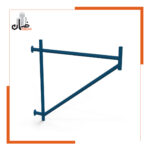
Cuplock scaffolding steel stair
The Cuplock scaffolding access stairway is a modular steel system designed to provide safe and standard-compliant vertical access between different scaffold levels at various heights.
This system typically consists of steel stair treads, side frames, guardrails, and landings, and is installed directly onto the Cuplock scaffolding structure.
The main advantages of the Cuplock steel stairway system include the following:
- Easy and fast installation through boltless connections, utilizing the core structure of the Cuplock scaffolding system, one of the most widely used scaffold systems worldwide.
- High level of safety due to the presence of guardrails and anti-slip stair treads.
- Standardized and modular design in full compliance with international safety standards.
- Reusable system thanks to its high durability and long service life.
- Improved worker productivity by providing convenient and fatigue-free access between scaffold levels.
- Use of adjustable base supports to ensure proper leveling of the stairway on uneven ground.
Cuplock scaffolding steel stair
What Is a Cuplock Scaffolding Steel Stair?
The Cuplock scaffolding steel stair is a key component of modern, prefabricated scaffolding systems and is recognized as an efficient and safe alternative to traditional scaffolding. This system, also known as cup-lock or hammer-lock scaffolding, utilizes mechanical connections instead of bolts and nuts. The term “Cuplock” or “Cup System” originates from its cup-shaped locking mechanism, which secures connections with a simple hammer strike, significantly accelerating the installation process.
Cuplock scaffolding tubes typically have a nominal wall thickness of approximately 2.3 mm. This relatively lower thickness compared to other steel scaffolding systems reduces the overall weight of the structure, making transportation and handling easier. However, the lighter weight requires strict compliance with standard spacing between verticals to maintain safety. Cuplock scaffolding is widely used in concrete shoring for large-scale structures such as slab falsework, bridge decks, heavy-duty support structures, as well as stair towers and complex concrete structures.
The Critical Role of Stairs in the Cuplock Scaffolding System
Scaffolding stairs play a vital role in providing safe and convenient access for workers to different levels of temporary structures. They serve as a secure alternative to traditional methods such as ladders or unstable planks, which significantly increase the risk of falls. Cuplock scaffolding stairs, thanks to their modular design and ease of connection to other system components, integrate quickly with the main scaffold structure. This integration greatly enhances circulation safety and allows workers to move between levels with minimal effort and fatigue, thereby improving overall project productivity.
System Integration: From a Single Component to a Complete Solution
Cuplock scaffolding stairs should not be considered merely as an auxiliary component, but rather as a critical element of an integrated system. This system-oriented approach ensures that the overall strength and stability of the scaffold are directly transferred to stair safety. Due to its cup-lock connections and steel tube structure, the Cuplock scaffolding system is capable of withstanding very high loads.
Since Cuplock stairs are easily connected to this robust structure, their safety is derived from the overall integrity of the system. Therefore, selecting Cuplock stairs from a reputable manufacturer represents an investment in a comprehensive and safe height-access solution. This integrated approach significantly contributes to reducing worker fatigue and increasing overall project efficiency.
Structure, Components, and Technical Specifications of Cuplock Steel Stairs
The scaffolding stair system consists of various components, each serving a specific function.
- Stair Treads: This component provides the walking surface for workers and is typically manufactured from chequered or perforated steel sheets to ensure anti-slip properties and maximum safety.
- Stringers and Supports: Stringers are inclined members that contribute to the overall strength of the stair structure, while supports are used to connect the stairs to landings and other scaffold components.
- Landing: In tall structures, landings are essential for connecting different stair sections and creating a safe and comfortable resting and movement area for workers. Landings play a critical role, especially in stair runs involving direction changes or turns.
- Main Standards: These vertical Cuplock scaffold tubes form the backbone of the structure, to which stairs and landings are securely connected.
Technical Specifications and Standard Dimensions
The dimensions of stairs and landings are determined in accordance with safety and functional standards.
- Stair Dimensions: The tread length is typically between 50 and 75 cm, with a minimum width of 30 cm.
- Landing Dimensions: Landings are generally 2 meters in length and 32 cm in width. Another reference cites landing dimensions of 200 × 25 cm, indicating the need to adapt dimensions to specific project requirements and manufacturer standards.
- Number of Steps: Each scaffolding stair unit must consist of between 6 and 14 steps.
- Base System: Depending on height, stair units are classified into 4-leg, 6-leg, and 8-leg systems. To prevent overturning and improve stability at greater heights, the number of scaffold bases must be increased.
Importance of Raw Materials and Surface Treatment
Material quality and surface coatings play a crucial role in the durability and safety of scaffolding stairs. Cuplock stairs are generally manufactured from high-strength steel or galvanized steel. Galvanizing, achieved by passing steel components through a molten zinc bath, significantly increases resistance to corrosion and rust, thereby extending the service life of the product. Similarly, surface coatings such as oven-baked industrial paint offer effective protection against adverse environmental conditions.
Technical Specification Table for Cuplock Scaffolding Stairs and Landings
This table has been prepared to provide accurate and reliable technical information for engineers and contractors.
| Component | Material / Finish | Standard Dimensions | Technical Notes |
|---|---|---|---|
| Stair Tread | Steel with galvanized or oven-baked paint finish | Length: 50–75 cm, Width: minimum 30 cm | Perforated or embossed surface for anti-slip performance |
| Landing | Steel with galvanized or oven-baked paint finish | Length: 2 m, Width: 32 cm (alternative source: 200 × 25 cm) | Mandatory for greater heights and changes in stair direction |
| Main Standards | Welded steel with galvanized coating | Nominal thickness: approx. 2.3 mm | Connection point for cup-lock joints |
| Number of Steps per Unit | – | 6 to 14 steps | Landings required as height increases |
| Base System | – | 4, 6, or 8 legs depending on height | More bases required for stability at higher elevations |
Outstanding Advantages of Cuplock Steel Stairs – Why This System Is the Preferred Choice
This section highlights the key competitive advantages of Cuplock steel stairs and explains why this system is considered a smart and cost-effective alternative to traditional methods.
Maximum Safety and Stability
One of the most important reasons for using Cuplock steel stairs is the significant improvement in worker safety. Anti-slip stair treads and the mandatory use of landings at greater heights greatly reduce the risk of falls. In addition, the Cuplock system’s high resistance to applied loads—particularly in concrete works—ensures overall project safety. By eliminating unsafe traditional access methods, this system creates a substantially safer working environment.
Speed and Ease of Installation and Dismantling
The exceptional speed of installation and dismantling is one of the main advantages of Cuplock scaffolding. By eliminating bolts and nuts and using cup-lock connections, the system dramatically reduces project execution time. Installation and dismantling can be performed with minimal manpower—sometimes only two workers—and without the need for highly skilled labor. These features significantly reduce labor costs and accelerate project progress.
Durability, Service Life, and Reduction of Operating Costs
Cuplock stairs offer high durability and long service life. Their steel construction and anti-corrosion coatings allow for repeated use across multiple projects. Ease of transportation and storage further reduces handling and warehousing costs. Taken together, these advantages mean that despite a higher initial investment compared to traditional systems, Cuplock stairs are more economical and cost-effective in the long term.
Flexibility and Wide Range of Applications
Thanks to adjustable base heights and variable spacing between components, the Cuplock system offers exceptional flexibility. This makes it suitable for a wide variety of structures with different shapes and heights, including building façades, load-bearing towers, and heavy-duty concrete shoring applications.
Comparison Between Cuplock Stairs and Traditional Access Methods
Contractors and engineers often rely on traditional methods such as ladders or planks due to familiarity and lower initial costs. However, a closer evaluation reveals critical differences between these approaches.
| Feature | Cuplock Scaffolding Steel Stairs | Traditional Methods (Ladders / Planks) |
|---|---|---|
| Safety | Very high (anti-slip steps, landings, rigid structural connection) | Low (high risk of slipping and falling, poor stability) |
| Installation Speed | Very high (no bolts or nuts required) | Low (time-consuming and labor-intensive) |
| Skill Requirement | Minimal requirement for skilled labor | Requires experienced and skilled workers |
| Durability and Service Life | High, reusable across multiple projects | Low, rapid wear and frequent replacement |
| Long-Term Cost | Cost-effective (reduced labor, maintenance, and replacement costs) | High (maintenance expenses and accident risks) |
This comparison demonstrates that choosing a modern system such as Cuplock stairs, despite higher initial costs, represents a smart long-term investment that reduces expenses and, more importantly, protects workers’ lives.
Market Analysis and Economic Value: New vs. Used Cuplock Stairs
This section examines pricing factors and provides a detailed comparison between new and used Cuplock stairs to help contractors make informed decisions for their projects.
Price Analysis and Influencing Factors
The price of Cuplock stairs is influenced by several factors, including the type and quality of raw materials (steel and galvanizing), dimensions and design, manufacturing processes, production volume (mass production reduces costs), and fluctuations in steel and currency markets. As a result, modular and prefabricated scaffolding systems are generally more expensive than traditional alternatives.
New vs. Used Cuplock Scaffolding Stairs: A Strategic Decision
The market offers both new and used scaffolding stairs. Purchasing used equipment may seem attractive for reducing initial costs, particularly for short-term projects. However, this decision involves hidden risks that must be carefully evaluated.
- Reduced Safety and Structural Integrity: Used stairs and tubes may suffer from corrosion, rust, deformation, or hidden damage that significantly compromises strength and safety. Visual inspections cannot always detect concealed defects.
- Non-Compliance with Standards: Used equipment may not comply with current national or international safety standards, increasing potential risks.
- Shorter Service Life: Used stairs generally do not provide the same durability or performance as new products and are unlikely to withstand repeated use across multiple projects.
- Higher Maintenance Requirements: Worn equipment requires more frequent inspection, repair, and maintenance, resulting in additional and unpredictable costs.
Comparison Table: New vs. Used Scaffolding Stairs
| Feature | New Stair Units | Used Stair Units |
|---|---|---|
| Initial Cost | Higher | Lower |
| Safety | Guaranteed, fully compliant with standards | Uncertain, risk of hidden defects |
| Durability and Service Life | Very high, suitable for multiple projects | Shorter, already worn |
| Maintenance Cost | Very low | Requires frequent maintenance and repairs |
| Reusability | Yes, without loss of quality | Limited, with reduced performance and safety |
The decision to purchase used equipment must be based on a careful assessment of risks and costs. Initial savings may not justify potential safety hazards and future expenses.
Installation, Maintenance, and Safety Guidelines: Toward Flawless Execution
This section outlines installation steps, common issues, and safety solutions to help contractors achieve optimal performance while minimizing risks.
Step-by-Step Installation Guide for Cuplock Steel Stairs
Proper installation of Cuplock scaffolding stairs is essential to ensure safety and efficiency. The following steps must be followed carefully:
- Planning: Determine the installation location and accurately measure dimensions, including required height and number of steps and landings.
- Site Preparation: The ground must be level, firm, and free from obstacles. On soft surfaces, base plates should be used to distribute loads.
- Installation of Standards and Bracing: Main scaffold standards are installed at standard spacings (1.8 to 2.3 meters depending on application). Cross bracing is added to enhance structural stability.
- Installation of Stairs and Landings: Stair treads and landings are securely connected to the main structure.
- Installation of Guardrails: To prevent falls, guardrails must be installed at heights of 55 cm and 110 cm from the working platform.
- Final Inspection: After installation, a comprehensive inspection is conducted to verify the integrity and security of all connections.
Common Issues and Safety Solutions
Many scaffolding incidents result from human error and non-compliance with standards—not from deficiencies in modern systems such as Cuplock, but from improper use. Common issues include:
- Use of Worn Equipment: Damaged or corroded couplers and tubes can compromise structural stability.
- Improper Installation: Inadequate bracing or the use of weak or insufficient planks increases the risk of collapse or falls.
- Incorrect Loading: Excessive or uneven loads on scaffold platforms may cause bending or component failure.
Safety solutions include daily equipment inspections, proper worker training, and strict adherence to manufacturer guidelines. The most effective accident prevention measure is investing in high-quality products from reputable manufacturers.
Zeman Competitive Advantage: Fully Robotic Production and Beyond-Industry Standards
This section highlights Zeman’s manufacturing advantages and explains how fully robotic production and stringent standards ensure exceptional quality and safety.
Fully Robotic Production: Guaranteed Precision and Superior Quality
Zeman is proudly recognized as the only Cuplock scaffolding manufacturer in Iran utilizing fully robotic production. This fundamental technical advantage directly impacts product quality and safety. In Cuplock systems, precision in connecting cup joints to standards is critically important.
Robotic manufacturing ensures that all connections are produced with maximum dimensional accuracy and without human error in welding or spacing. This high precision enables fast and flawless installation on site, as all components fit together seamlessly without the need for additional adjustments. Therefore, purchasing from Zeman represents an investment in a product whose safety and performance are guaranteed from the manufacturing stage onward.
Compliance with National and International Standards
Zeman products stand out not only in terms of manufacturing processes but also in their strict compliance with standards. Robotic production ensures full adherence to national standards such as ISIRI 15443, covering material quality, structural strength, and proper design. This commitment provides contractors and engineers with greater confidence and assurance.
Conclusion
Cuplock scaffolding steel stairs are recognized as a modern, safe, and efficient access solution in the construction industry, significantly enhancing worker safety and project execution speed. Key advantages—including fast installation and dismantling, high durability, and application flexibility—make this system a logical and economical choice over the long term. While purchasing used equipment may appear attractive, the hidden risks associated with reduced safety and durability make investing in new, high-quality products the smarter decision.
By leveraging fully robotic production technology, Zeman delivers products that exceed industry standards and guarantee the highest levels of precision, quality, and safety. For expert consultation and comprehensive scaffolding solutions for construction projects, contacting Zeman’s specialists is strongly recommended.
Get expert advice
Our sales experts at Zaman are ready to provide guidance and advice before your purchase.

Reviews
There are no reviews yet.